
In my classes with babies, there is a moment I wait for every week. I tap the drum once, a baby looks right at me and says “ba!” So I say “ba!” back. The baby’s eyes go wide, there’s a pause, and then comes another “ba!”, louder this time. We go back and forth like that until one of us starts giggling.
That little exchange has a name. Researchers call it serve and return, and it turns out to be one of the most powerful things a grown-up can do for a baby’s language. Here is what serve and return means, what the research says about it, and how to fit it into the most ordinary parts of your day.
What Serve and Return Means
The term comes from the Center on the Developing Child at Harvard University, and it borrows from tennis. Your baby serves by babbling, looking at something, pointing, reaching or making a face. You return the serve by noticing and responding, with a word, a smile, a sound back, or by naming the thing they are looking at. Then you wait, and your baby takes another turn.
What makes it work is the back-and-forth. Talking at a baby is lovely, but talking with a baby, and leaving space for them to answer, is where the real learning happens.
Why Conversation Matters More Than Word Count
You may have heard about the “30 million word gap”, the idea that children who hear more words do better with language. Newer research suggests that the number of words matters less than the number of conversations.
In one study, researchers recorded the home language of 36 children aged 4 to 6 and then scanned their brains while they listened to stories. Children who had more back-and-forth conversational turns with adults showed more activity in a key language area of the brain, and that activity helped explain the link between their home language and their verbal skills. The number of adult words alone did not show the same effect (Romeo et al., 2018).
Another study followed 146 babies and toddlers whose days were recorded at home. The number of conversational turns at 18 to 24 months predicted their vocabulary, verbal comprehension and IQ scores about ten years later, even after accounting for family socioeconomic status (Gilkerson et al., 2018). These studies show strong links, not guarantees, but they point in the same direction. Taking turns matters.
QUICK SCIENCE: Even babbling is a conversation. In one study, mothers of 9-month-old babies responded to their baby’s babbling either right after the baby made a sound or at random times. Babies whose mothers responded right away quickly changed their babbling to include sound patterns from their mothers’ speech, and babies who got random responses did not (Goldstein & Schwade, 2008). The timing of your answer seems to teach your baby that their sounds are worth making.
How to Do Serve and Return All Day
You don’t need to set aside special time for this. The best moments are the ordinary ones: diaper changes, bath time, the grocery store, the car.
1. Notice the serve. Watch what your baby is looking at, reaching for or babbling about. A serve can be very small.
2. Return it. Smile, copy their sound, or say something about it: “Oh, you see the dog!”
3. Name it. Give the word for what they are interested in. Babies learn words best when the word matches what they are already paying attention to.
4. Wait. This is the step most of us skip. Count to five in your head and give your baby time to take their turn.
5. Notice when they are done. When your baby looks away or fusses, that is a signal they need a break. Letting the conversation end is part of it too.
Serve and Return With Toddlers
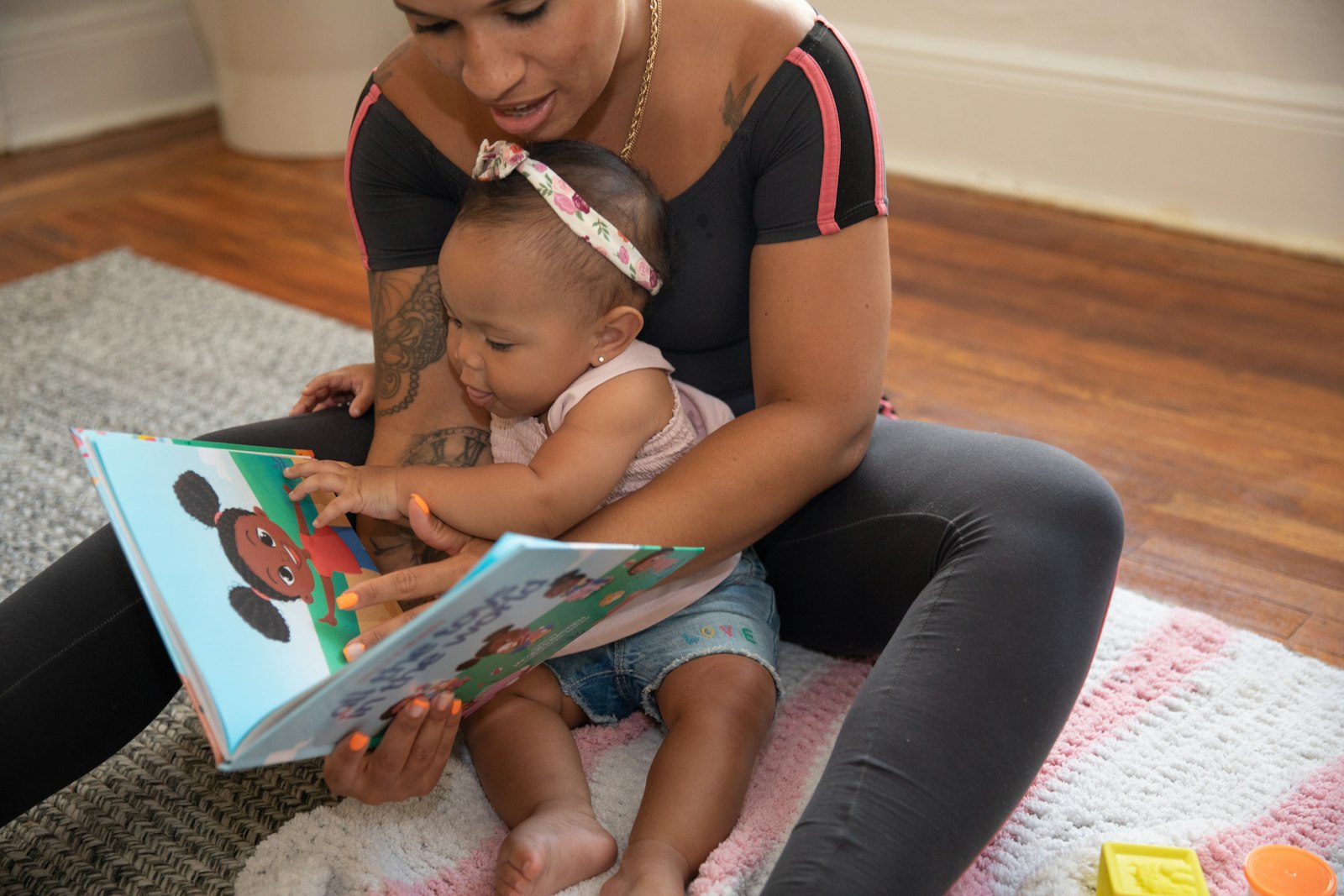
Serve and return doesn’t stop when your child starts talking. A toddler’s serves get bigger and louder, like a pile of “why?” questions, a dramatic story about a dog at the park, or a block tower held up for you to see. Returning those serves still means stopping, looking and answering, and it is how toddlers learn that their ideas are worth sharing.
With toddlers, try asking questions that can’t be answered with yes or no, like “What do you think the dog was doing?” and then waiting for the whole answer, even if it takes a while. Repeating back what they said with a little more added (“The dog ran fast! The dog ran fast after the ball!”) gently shows them the next step in language without correcting them.
Singing Counts Too
Songs are full of built-in serve and return. Call-and-response songs, animal sounds in Old MacDonald, and songs with a pause before the last word all invite your child to take a turn. A baby who can’t say the words yet can still take a turn with a squeal, a clap or a kick, and every turn counts.
I wrote more about singing with very young children in music for babies, and about why little ones want the same songs over and over in why toddlers love repetition.
TRY THIS AT HOME: Pause the song. Sing a song your child knows well, like Twinkle, Twinkle, Little Star, and stop just before the last word of a line: “Twinkle, twinkle, little…” Then wait, with a big expectant face. A baby might squeal or kick, and a toddler might shout “star!” Either way, they took a turn, and you return it with a big smile and the next line.
What to Skip
Drilling with flashcards. Babies learn words through back-and-forth with people, not through being quizzed.
Filling every silence. Narrating everything you do is fine, but leave pauses so your baby can answer.
Background screens. A TV or phone on in the background tends to pull a grown-up’s attention away, and serve and return depends on noticing those small serves. I wrote more about this in why screen-free matters in early childhood.
THE MAILBOX MELODIES METHOD: Many of the songs on every CD have pauses, call-and-response and sound effects built in, so a grown-up and a child naturally take turns while they sing. The songs are meant to be sung together, not just listened to, and each one is tried out on a real room of little ones in my weekly classes before it ships. Mailbox Melodies is a kids music mail membership for ages 0 to 6+, $19 a month, and an envelope with your child’s name on it ships on the 15th.
References
- Romeo, R. R., Leonard, J. A., Robinson, S. T., West, M. R., Mackey, A. P., Rowe, M. L., & Gabrieli, J. D. E. (2018). Beyond the 30-million-word gap: Children’s conversational exposure is associated with language-related brain function. Psychological Science, 29(5), 700–710. Link
- Gilkerson, J., Richards, J. A., Warren, S. F., Oller, D. K., Russo, R., & Vohr, B. (2018). Language experience in the second year of life and language outcomes in late childhood. Pediatrics, 142(4), e20174276. Link
- Goldstein, M. H., & Schwade, J. A. (2008). Social feedback to infants’ babbling facilitates rapid phonological learning. Psychological Science, 19(5), 515–523. Link
Questions Parents Ask About Serve and Return
When should I start serve and return with my baby?
From birth. A newborn’s serves are small, like a glance, a coo or a stretch, but responding to them is already part of the back-and-forth.
What if my baby doesn’t babble much yet?
Respond to whatever they do give you, like looking, smiling, kicking or reaching. Every one of those is a serve. If you have concerns about your child’s speech or hearing, your pediatrician is the right person to ask.
Is it okay to use a sing-song baby voice?
Yes. The slow, high, sing-song way many grown-ups naturally talk to babies seems to help babies tune in. Just remember to pause and let your baby answer.
Do audiobooks and recordings count?
They are lovely, but they can’t respond to your child, so they don’t give the same back-and-forth. Use them alongside conversation, not instead of it.
How much talking is enough?
There is no target to hit. Focus on the quality of the moments rather than counting words. A handful of real back-and-forth exchanges during everyday routines adds up quickly.
— Ms. Chelsea
Written by
Ms. Chelsea
Before starting Mailbox Melodies, Chelsea created Grape Jammers Music, a music education business in Napa, California, where she still teaches toddler music classes today. She has also taught preschool, is classically trained in voice, and has over 30 years of stage experience — including professional performances at Disneyland and SeaWorld. These days she writes and records the songs, draws the zines, and packs every envelope herself, and tries it all out on her own two little ones for inspiration.
Read Chelsea’s letter →How it works
Music class, delivered to your mailbox
Songs with pauses and call-and-response built in, on a CD with your child’s name on the envelope every month.
Join
Sign up in under a minute, for your family or as a gift.
Ms. Chelsea gets to work
She writes and records the month’s songs and packs every envelope herself.
Watch the mailbox
Real mail with your child’s name on it, right to your mailbox. Pop in the CD and music class begins at home.
$19 a month · ships on the 15th · cancel anytime
See How It WorksScreen-free music mail for developing minds.