
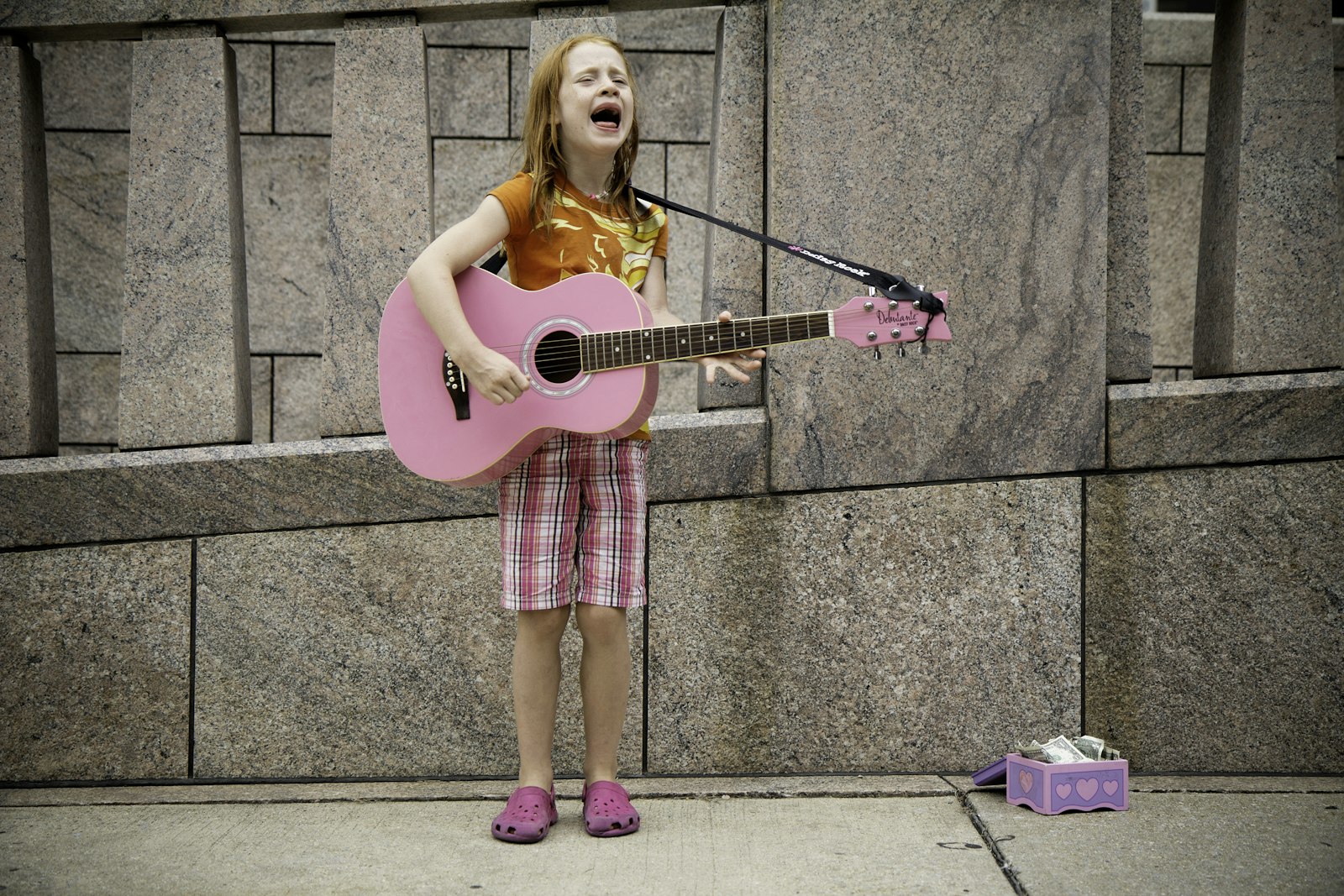
Four-year-olds do a thing I never saw at any other age. They’ll finish a song, look directly at you, and wait — not for praise exactly, but for confirmation that you witnessed it.
I once had a four-year-old stop a whole class because I’d looked down at my ukulele during her big note. She waited. Everyone waited. I looked up, she did the note again, and only then did we continue.
That’s four. The music is no longer just something happening — it’s something being performed, and a performance needs a room. (The full toddler guide has the whole arc; this is the four-year-old stretch.)
What Changes at Four
Three big shifts, and they all point the same direction.
Intention. A three-year-old’s invented song wanders. A four-year-old’s has a plan — a beginning, a loud part, an ending they’ve decided on. They’re not improvising anymore; they’re composing, badly and with total conviction.
Turn-taking. This is the year children can genuinely play music with each other rather than near each other. Some research suggests joint music-making is associated with increases in cooperative and helping behavior in four-year-olds.[1] I’d hold the causal claim loosely, but the effect in a room is unmistakable: children who have just drummed together are noticeably nicer to each other for a while afterward.
Dynamics. Loud and quiet become tools rather than accidents. A four-year-old can be asked to sing something as a whisper and will do it — and will find it hilarious.
What hasn’t arrived yet is steady beat. Most fours still can’t reliably clap in time, and that’s on schedule; beat-keeping firms up closer to five and six.
QUICK SCIENCE Waiting for your turn on the drum is real practice at self-regulation — and unlike most practice at it, four-year-olds volunteer for it. (The same skill, in a different setting.)
Songs That Work at Four
Four wants songs with a job to do: a part to play, a rule to follow, or a joke to land.
Bingo — the letter-drop game. Each verse removes a letter and replaces it with a clap. It’s the first song many children find genuinely challenging in a way they enjoy.
John Jacob Jingleheimer Schmidt — a whole song about volume. Loud verse, quiet verse, everyone shouting the last line. Fours will ask for this one until you regret introducing it.
If You’re Happy and You Know It — extended — at four, let them invent the verses. “If you’re happy and you know it, hop like a frog.” The inventing is the activity.
The Green Grass Grew All Around — a cumulative song with a long chain to remember. Four-year-old memory is up to it, just barely, which is what makes it fun.
Little Bunny Foo Foo — a story song with a plot, a villain, a moral, and a genuinely strange ending. Threes like stories; fours like stories with rules.
Shake My Sillies Out — a movement song they can lead. Hand over the leading and they’ll take it seriously.

Three Things to Try This Week
Give them the stop button. Play a song and let your four-year-old be the one who calls “stop!” and “go!” while everyone freezes and unfreezes. Being in charge of the music is more interesting to a four-year-old than the music.
Make a two-instrument band. You take a pot, they take a pot. Play together, then take turns — one plays while the other listens, then swap. The listening half is the part that’s actually hard.
Do loud and soft as a game. Sing a song at a whisper, then a shout, then a whisper again. Then let them conduct it — hand up for loud, hand down for soft.
TRY THIS AT HOME Have a two-minute concert after dinner. One person performs, everyone else is the audience, and then you swap. The rule that matters is that the audience is quiet — it’s the closest thing to a listening lesson a four-year-old will sit through.
What You Can Skip
Skip the “is she gifted?” question. A four-year-old who sings in tune, remembers every word, and performs constantly is a four-year-old who likes singing. It’s a wonderful thing and it predicts very little about anything.
Skip forcing an instrument. Four is when a lot of families start wondering about lessons. Some four-year-olds are ready; most aren’t, and starting early doesn’t buy the years back later. If they’re asking, try it. If you’re asking, wait.
Skip over-scheduling. A music class, a soccer practice, and a swim lesson in one week is a lot for four. If music becomes a thing they’re driven to rather than something that happens at home, you’ve lost the better half of it.
Skip the critique. Fours are newly self-conscious. “That was a bit loud” from someone they love lands harder than you’d expect.
Where Mailbox Melodies Fits at Four
Four is the age where the whole envelope gets used, and where children start having opinions about it.
A four-year-old can open it themselves, recognize their name, sort out which part is the CD and which is the zine, and tell you which song is the good one. The crafts get made properly this year, sometimes better than I made the prototype. The stickers get negotiated over.
Musically, what I write for this age has more parts to play — call-and-response, verses where they take a line, moments to be loud on purpose. That’s the four-year-old’s whole appetite, and I know it holds because I test every one of these in class before it ships. On the 15th of every month it ships with their name on the envelope: CD, zine, stickers, and often a craft, with a download code if you want it in the car. $19 a month, shipping included, cancel anytime.
- Kirschner, S., & Tomasello, M. (2010). Joint music making promotes prosocial behavior in 4-year-old children. Evolution and Human Behavior.
Questions Parents Ask About Music at Four
Should my four-year-old be able to clap in time yet?
Usually not reliably, no. Steady beat is one of the later musical skills and it typically firms up between five and seven. If your four-year-old claps roughly with the music some of the time, that’s normal and it will keep improving on its own.
Is this a good age to start piano lessons?
It can be, for a child who is asking and who can sit for ten focused minutes. The best predictor isn’t musical ability, it’s whether they can handle the boring parts. If they can’t yet, waiting a year usually turns a fight into a hobby.
My four-year-old only wants to sing pop songs from the car radio. Is that bad?
Not bad, and honestly a good sign — they’re paying attention to music in the wild. I’d just keep the sung-together, made-up, silly repertoire alive alongside it, because that’s the part that involves them rather than plays at them.
They sing the same song at top volume all day. Any advice?
Give the song a place. “That’s a backyard song” or “that’s a car song” works better than asking them to stop, because it doesn’t ask them to give up the thing — just to move it.
What should I expect at five?
The beat, mostly. Five is when timing arrives, and with it a new kind of pride in getting something exactly right.

— Ms. Chelsea
Written by
Ms. Chelsea
Before starting Mailbox Melodies, Chelsea created Grape Jammers Music, a music education business in Napa, California, where she still teaches toddler music classes today. She has also taught preschool, is classically trained in voice, and has over 30 years of stage experience — including professional performances at Disneyland and SeaWorld. These days she writes and records the songs, draws the zines, and packs every envelope herself, and tries it all out on her own two little ones for inspiration.
Read Chelsea’s letter →How it works
Music class, delivered to your mailbox
The songs in this article are the kind I write every month — and mail to your child with their name on the envelope.
Join
Sign up in under a minute, for your family or as a gift.
Ms. Chelsea gets to work
She writes and records the month’s songs and packs every envelope herself.
Watch the mailbox
Real mail arrives with your child’s name on it. Pop in the CD and music class begins at home.
$19 a month · ships on the 15th · cancel anytime
See How It WorksScreen-free music mail for developing minds.