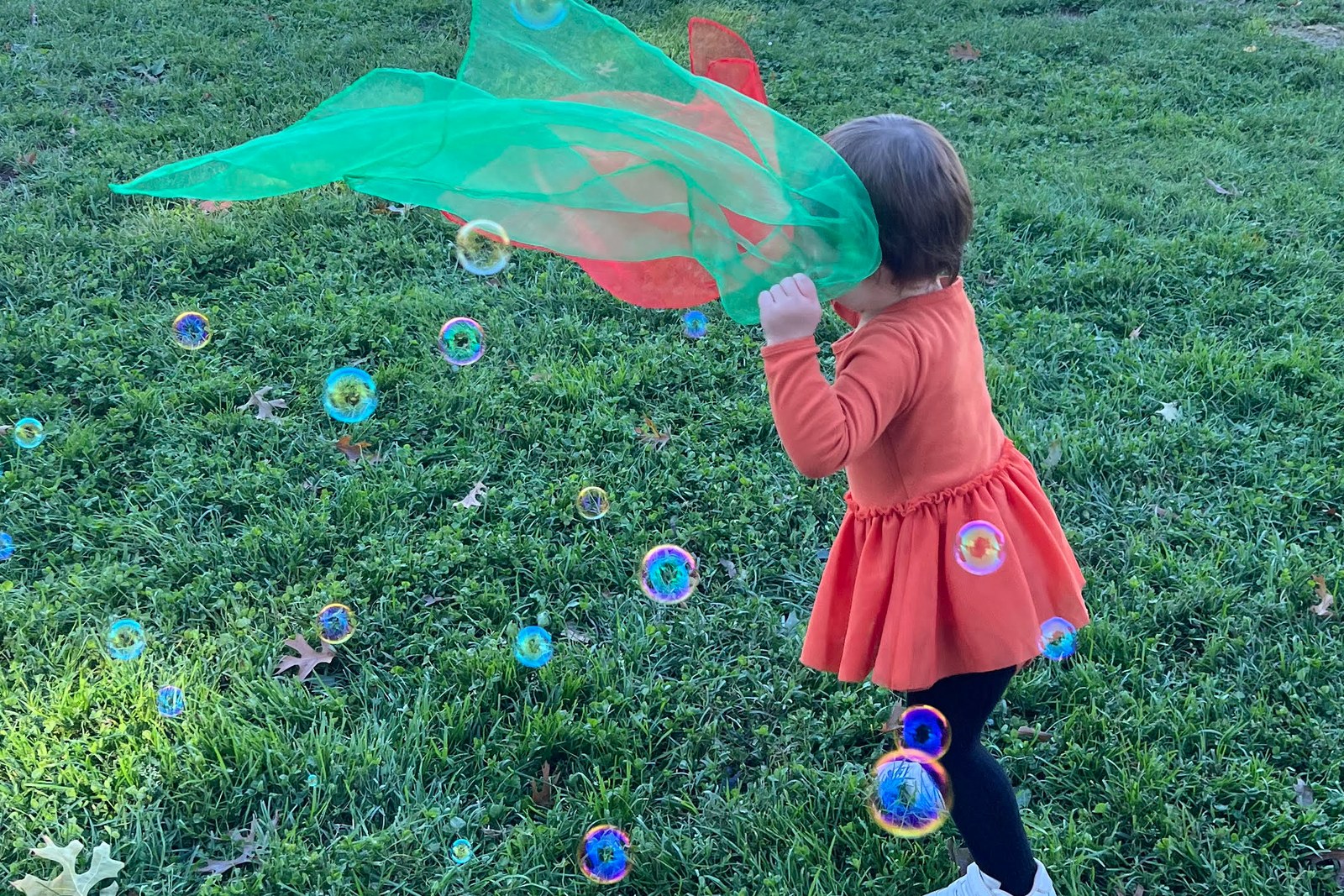
A three-year-old once stopped me halfway through “The Itsy Bitsy Spider” to ask, with real concern, where the spider went after the rain washed it out. Not whether it was okay — where it went. She wanted the next scene.
I didn’t have one. We made one up on the spot, and for the rest of that term the spider had a whole life: a job, a friend, an apartment behind the drainpipe.
That’s three. The songs stop being sound-shapes and start being stories, and the moment they become stories, your child wants to know what happens next — and then to change it.
Three Is the Year of the Question
At two, a song is a pattern to be learned. At three, it’s a situation to be understood.
Three-year-olds are in a language explosion. Most are speaking in full sentences, asking constant questions, and — this is the important one for music — beginning to pretend.[1] Pretending changes what a song can do. A two-year-old sings “Old MacDonald” because the pause is fun. A three-year-old sings it and wants to know why the farmer has that many animals.
Musically, a few real things arrive this year. Pitch starts to get closer, though still loosely — many threes can carry the contour of a song, the ups and downs, even when individual notes wander[2]. Songs get longer; a three-year-old can hold three or four verses in their head. And they start singing spontaneously, to themselves, while playing. That last one is the sign I always watched for. Private singing means the music has fully moved in.
QUICK SCIENCE Made-up songs are not a sideshow at three — they’re the main event. A child inventing a song about their sandwich is doing exactly what they’ll later do with sentences and stories. Don’t correct it, and don’t request a performance of it.
Three is also, not coincidentally, the age where music starts doing serious work in a daily routine. A song that means “we’re leaving now” gets less resistance than a sentence that means the same thing — and predictability is the reason.
Six Songs That Hold a Three-Year-Old
At this age you want songs with characters, verses, or a problem to solve.
Old MacDonald — still working, but differently. At three, hand them the choice of animal and let the song go somewhere strange. A farm with a dinosaur on it is a three-year-old’s idea of a great joke.
Baa Baa Black Sheep — a small story with three characters and a satisfying distribution of bags at the end. Threes like knowing who gets what.
Five Little Ducks — the first song many children find genuinely sad, then genuinely relieving. That arc — loss, then return — is a lot of what three-year-olds are working through anyway.
The Ants Go Marching — counting, a marching beat, and a new verse each time. It rewards a child who can now remember what number comes next.
She’ll Be Coming ’Round the Mountain — cumulative songs are a three-year-old’s memory gym. Each verse adds one thing to hold onto, and holding on is the fun part.
Down by the Bay — the rhyming song. Three is early for rhyme, and that’s exactly why this one is worth doing; you supply the rhyme for a while, then one day they beat you to it.
Three Things to Try This Week
Change one word and see if they catch you. Sing “Twinkle, twinkle, little dog” with a completely straight face. A three-year-old’s outrage here is a sign of exactly how well they know the song.
Give the song a next verse. Ask what happened after — after the spider climbed, after the ducks came back. Write down whatever they say. You are not being cute; you’re doing narrative work with a willing collaborator.
Sing the transitions. Make up a leaving-the-house song, a tidying-up song, a getting-in-the-car song. They can be four notes long and terrible. Three-year-olds resist instructions and follow songs, and I have never fully understood why, but it is reliably true.
TRY THIS AT HOME Make a “song of the day” and let your three-year-old choose it in the morning. Choice is the thing they’re hungry for at this age, and it costs you nothing. The same song may win for a week straight, which is fine.
What You Can Skip
Skip correcting the pitch. A three-year-old singing off-key is a three-year-old singing. Correcting it is the single fastest way I know to make a child stop singing in front of you — and once they stop, it takes a long time to come back.
Skip performance requests. “Sing the song for Nana” turns a private, exploratory thing into a test. If Nana wants to hear it, Nana can be in the room while it happens naturally.
Skip formal lessons. Three is early for structured instrument instruction for most children. Nothing is lost by waiting, and something is often lost by starting before a child is asking.
Skip worrying about musical talent. There’s no useful signal at three. The child who sings all day and the child who never does can end up in exactly the same place.
Where Mailbox Melodies Fits at Three
Three is the age the envelope really starts to be theirs.
A three-year-old recognizes their own name in print, and the arrival becomes an event — I hear from families that the mailbox check starts a day or two early. That anticipation is worth something on its own, and it’s the part I didn’t fully predict when I started.
What’s in it this year gets used properly for the first time. The zine’s activities are doable at three with a bit of help. The craft actually gets made. The stickers end up somewhere intentional. And the songs are long enough now to have verses your child will ask about — verses I’ve already tried out on a room of three-year-olds, who are a famously unforgiving audience. It ships on the 15th of every month with their name on the front, $19 a month, shipping included, cancel anytime.
- Centers for Disease Control and Prevention — Important Milestones: Your Child by Three Years.
- Trehub, S. E. (2003). The developmental origins of musicality. Nature Neuroscience.
Questions Parents Ask About Music at Three
My three-year-old sings constantly and it’s all off-key. Should I do anything?
Nothing at all, other than enjoy it. Pitch accuracy typically firms up between four and six, and it firms up faster in children who sing a lot — which means the off-key singing is the practice, not the problem.
Is three too young to start piano or violin?
For most children, yes — not because they can’t touch the instrument, but because formal practice asks for a kind of sustained attention that usually isn’t there yet. Some Suzuki programs start at three and work well for particular families. If your child isn’t asking, waiting a year or two costs nothing.
My child makes up songs that go on forever. Is that normal?
Very. Spontaneous, rambling, plotless invented songs are one of the most reliable markers of this age. They’re doing with melody what they’re doing with language — running it just to see where it goes.
How do I use music to stop the leaving-the-house battle?
Same song, every time, starting before the resistance does. The song has to be a signal rather than a negotiation, which means it can’t only appear when things are already going badly.
What changes at four?
Volume, mostly, and making things up on purpose rather than by accident — the four-year-old year is when children start performing deliberately. The full toddler guide has the whole arc if you want to see what’s ahead.

— Ms. Chelsea
Written by
Ms. Chelsea
Before starting Mailbox Melodies, Chelsea created Grape Jammers Music, a music education business in Napa, California, where she still teaches toddler music classes today. She has also taught preschool, is classically trained in voice, and has over 30 years of stage experience — including professional performances at Disneyland and SeaWorld. These days she writes and records the songs, draws the zines, and packs every envelope herself, and tries it all out on her own two little ones for inspiration.
Read Chelsea’s letter →How it works
Music class, delivered to your mailbox
The songs in this article are the kind I write every month — and mail to your child with their name on the envelope.
Join
Sign up in under a minute, for your family or as a gift.
Ms. Chelsea gets to work
She writes and records the month’s songs and packs every envelope herself.
Watch the mailbox
Real mail arrives with your child’s name on it. Pop in the CD and music class begins at home.
$19 a month · ships on the 15th · cancel anytime
See How It WorksScreen-free music mail for developing minds.