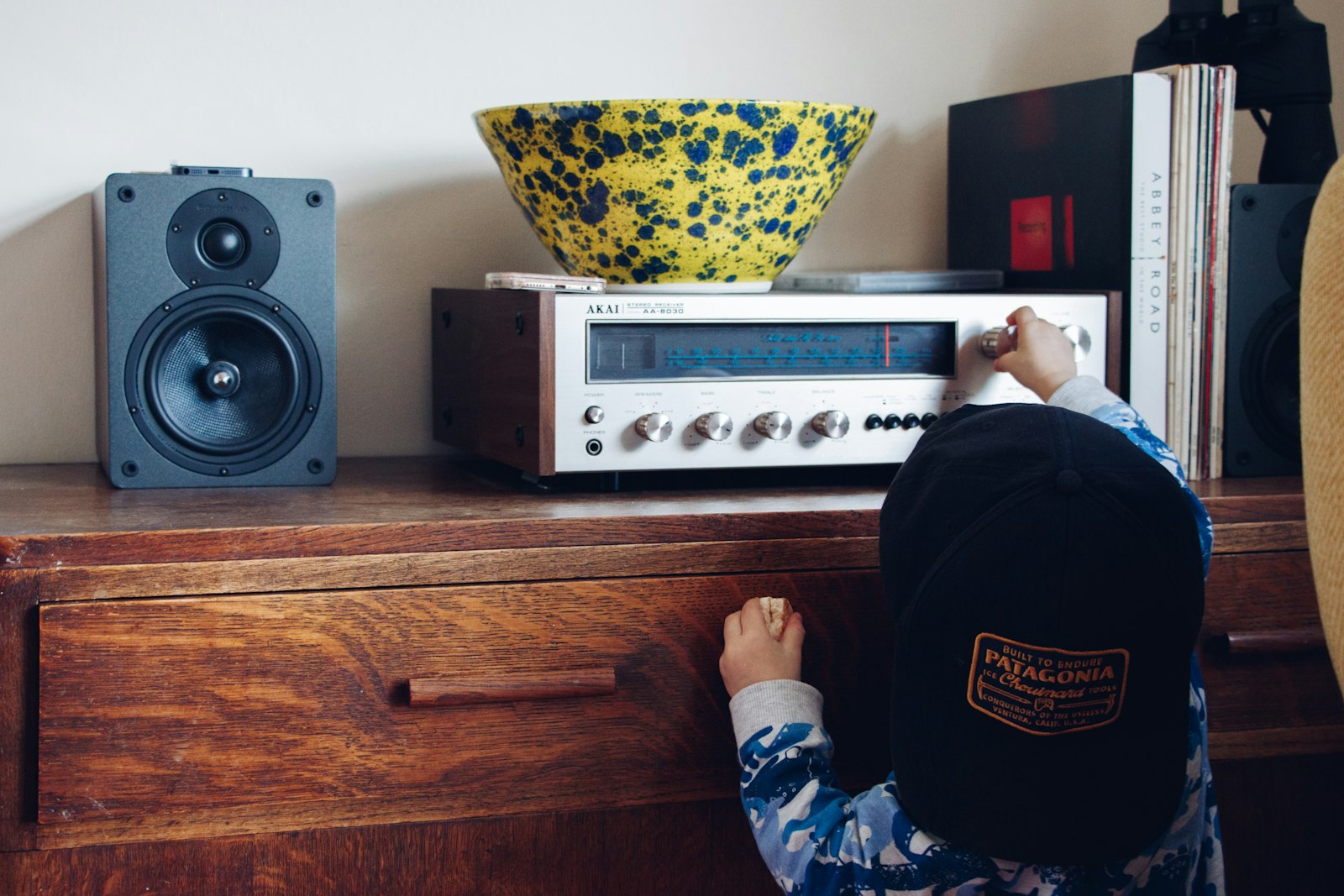
Every few weeks a parent stays behind after my Grape Jammers class to ask some version of the same question: what should we get so she can put music on by herself? Some call it a music box and some call it a music player, but they nearly always mean the same thing, something a two-year-old can work alone that isn’t a phone or a tablet.
I love that question, because it comes from a good instinct. A toddler who can choose a song, start it and play it again is getting a small taste of independence that most of their day doesn’t offer. So here is how I would choose a music box for toddlers, what each kind of player does well, and the one thing I think matters more than any of them.
What to Look for in a Music Box for Toddlers
I put every player through the same four questions, and they work just as well standing in the toy aisle.
Can a toddler work it alone? Look for big buttons, one obvious way to start the music and nothing to scroll through. If a grown-up has to open an app every time, it is really the grown-up’s player.
Is it screen-free? Some players are completely, and some quietly depend on a parent’s phone. The American Academy of Pediatrics recommends avoiding screen media other than video chat before 18 months and keeping it to about an hour a day of high-quality programs from ages 2 to 5 (AAP, 2016), so a player that keeps music away from screens makes those guidelines much easier to live with.
Will it survive a toddler? It will be dropped, sat on and carried up the stairs by its handle. I look for rounded corners, a sturdy case, a battery door that closes with a screw and a volume that tops out somewhere sensible.
What does it really cost? The price on the box is only the beginning. Cards, figures, discs or a streaming plan are where the money goes over a year, so it is worth adding those up before you choose.
Music Players for Toddlers at a Glance
Here is how the five most common options compare. Prices are typical US prices in fall 2026 and move around a lot with sales.
| Player | Can a toddler work it alone? | Screens or apps? | Typical upfront cost | Ongoing cost |
|---|---|---|---|---|
| Wind-up or pull-string music box | Yes, from about 12 months | None | $15 to $35 | None, but it plays one tune |
| CD player | Yes, from about 2 with a little practice | None | About $30 to $60 | CDs, free from the library or bought new |
| Yoto Mini or Yoto Player | Yes, the maker suggests 3 and up | App for setup and some content | About $60 to $150 | Cards, plus an optional Yoto Club membership |
| Toniebox | Yes, the maker suggests 1 and up | App for setup | About $100 for a starter set | Figures at about $15 to $20 each |
| Smart speaker or phone streaming | Not really, it needs voice commands or a parent | Usually a parent’s phone or app | About $30 to $100 | Free with ads, or about $13 to $22 a month |
The Players, One by One
A Wind-Up or Pull-String Music Box
This is the oldest kind of music box, and for babies and young toddlers it is lovely. They pull the string or turn the key, a tune plays and slowly winds down. That little loop of cause and effect is exactly the kind of thing a one-year-old will happily repeat thirty times in a row. The limit is that it plays one tune forever. Choose one made for babies, with no glass and no small parts, and treat it as part of the bedtime routine rather than their whole music library.
A CD Player
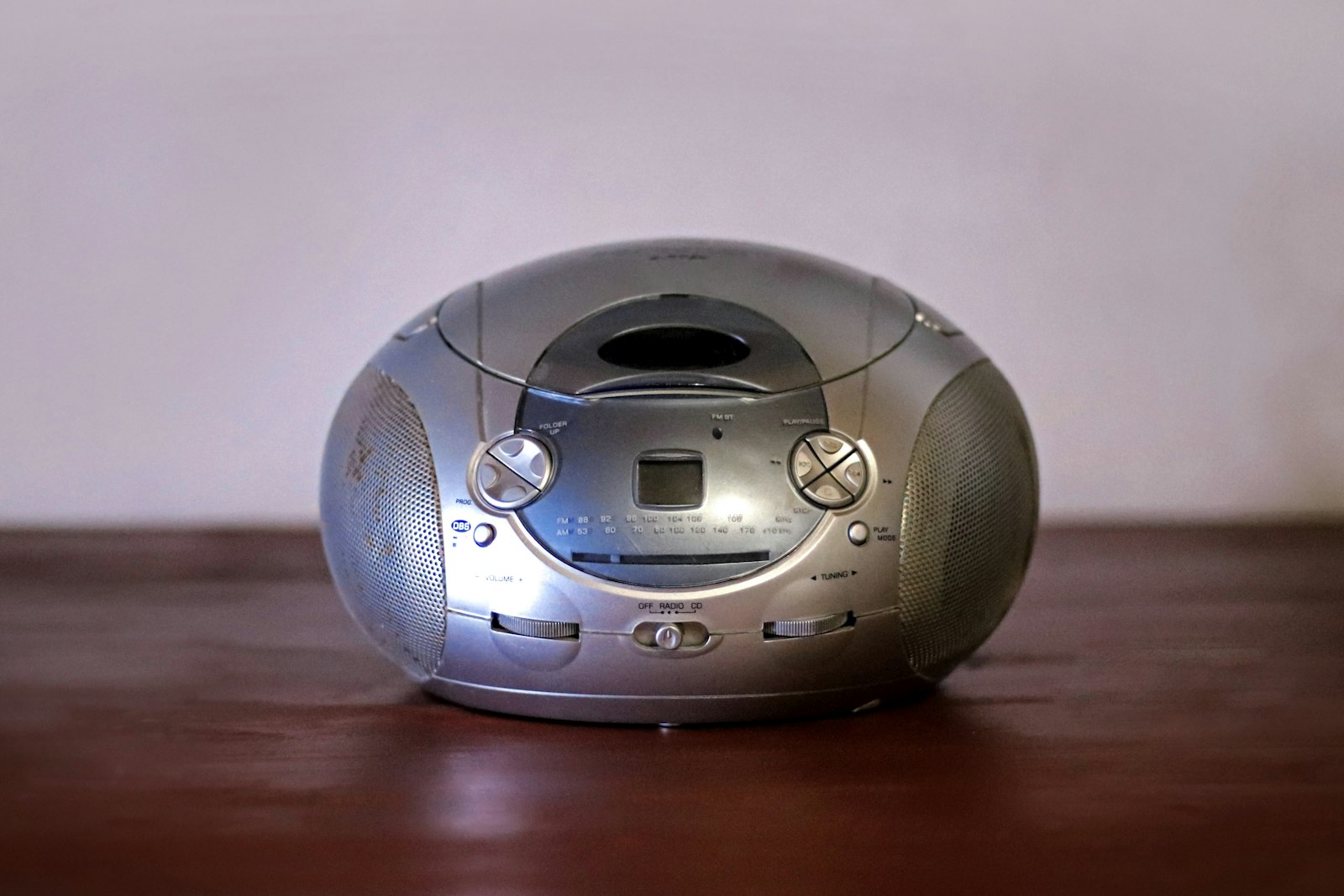
This is the one I recommend most often, and I should be upfront that I have a reason to like it, because my kids music mail membership ships on CDs. But the reasons hold up without me. A CD is something a toddler can hold, choose and put in by themselves, and each button does one thing. Nothing decides what plays next, and there is nothing to unlock.
The one I point parents to is the Retekess TR621, a sturdy little boombox for around $50. (That is an Amazon affiliate link, so I earn a small commission if you buy through it, at no extra cost to you.) Most libraries lend children’s CDs for free, which makes a CD player the cheapest option here to keep going for a whole year. I go into the trade-offs in more detail in CDs vs streaming for kids.
Yoto
If you would like a card-based player, Yoto is the one I would choose. Each card holds an album or a story, a child slots it in, and the chunky dials do the rest. It grows with a child better than anything else on this list, there is a lot of good content from independent artists, and the free radio and podcasts add plenty without buying more cards. A parent does need the app to set it up, and the newest models cost more than the older ones that are often on sale.
Toniebox
Toniebox works in a similar way with small figures instead of cards, and very young children love setting a figure on top and hearing it start. My hesitation is the controls. Tapping and tilting the whole box to skip a track, and squeezing its ears for volume, can get rough and overstimulating with toddlers, and the figures add up quickly. I compared the two side by side in Yoto vs Toniebox if you are deciding between them.
A Smart Speaker or Streaming From Your Phone
This is the cheapest way to have every song in the world, and it is also the hardest for a toddler to use alone. Voice assistants often misunderstand small children, and streaming keeps the phone, and its screen, at the center of the routine. I use streaming myself in the car, but I wouldn’t call it the child’s player.
The Player Matters Less Than What Is on It
After years of watching toddlers with music, the thing I am most sure of is that the player matters far less than the songs on it, and the people they hear those songs with.
There is a lovely study about this. Researchers asked parents to sing a new song to their five-month-old babies for one to two weeks. Afterward, the babies watched videos of two strangers, one singing the familiar song and one singing a new one, and they paid more attention to the stranger singing the song they knew. Babies who had heard the same song only from a musical toy didn’t show that preference, and the more the song had been sung at home, the stronger the effect tended to be (Mehr, Song & Spelke, 2016). For a baby, it seems, a familiar song carries a message about the person singing it.
QUICK SCIENCE: Repetition is part of how young children learn, and it shows up outside music too. In one storybook study, three-year-olds who heard the same stories read again and again learned more new words than children who heard the same words spread across different stories (Horst, Parsons & Bryan, 2011). It was a small study, so I wouldn’t stretch it too far, but it matches what I see in class every week. The tenth time through a song is usually when a toddler starts to sing it back. A player they can restart on their own is doing real work, even when you have heard that song more times than you can count.
So whichever player you choose, the best thing you can do with it is sing along. A toddler who hears you singing the same songs they play on their own is getting the part that matters most.
THE MAILBOX MELODIES METHOD: This is why every Mailbox Melodies envelope comes with a CD rather than a link. A new set of songs ships on the 15th of each month with the child’s name on the envelope, along with a booklet, stickers and fun extras, and sometimes a craft. Every song is tried out on a real room of toddlers in my weekly classes before it ships, and each one is written to be easy for a grown-up to sing along with. It is made for ages 0 to 6+, and it plays on any CD player.
My Recommendation, by Age
Under 12 months: a soft pull-string music box as part of the bedtime routine, played outside the crib, and your own voice for everything else.
1 to 2 years: a simple CD player kept low on a shelf where they can reach it, with a couple of CDs they know well.
2 to 4 years: a CD player or a Yoto, depending on whether your family would rather collect discs or cards. Both let a child choose and replay songs on their own.
4 and up: either one, plus a turn at choosing the music in the car. Older children love being in charge of the soundtrack.
If you are shopping for a gift, I keep a longer list of instruments and musical toys in my guide to the best musical gifts for toddlers, and grandparents will find more ideas in my list of Christmas gifts for grandchildren.
References
- Council on Communications and Media (2016). Media and young minds. Pediatrics, 138(5), e20162591. Link
- Mehr, S. A., Song, L. A., & Spelke, E. S. (2016). For 5-month-old infants, melodies are social. Psychological Science, 27(4), 486–501. Link
- Horst, J. S., Parsons, K. L., & Bryan, N. M. (2011). Get the story straight: Contextual repetition promotes word learning from storybooks. Frontiers in Psychology, 2, 17. Link
Questions Parents Ask About Music Players
What is the best music box for toddlers?
For most families, a sturdy CD player. A toddler can choose a disc and start it alone, it needs no app or screen, and libraries lend CDs for free. If you would rather have a card-based player, Yoto is the one I would pick.
At what age can a toddler use a music player on their own?
A pull-string music box works from about 12 months. Most toddlers can manage a simple CD player at around 2 with a little practice. Yoto suggests its players for ages 3 and up, and Toniebox for ages 1 and up.
Are Yoto and Toniebox screen-free?
The players themselves are, which is a big part of their appeal. Both need a parent’s phone and app to set up and manage content, so the screen is still there, just on the grown-up’s side.
Are music boxes safe for babies?
Choose one made for babies, with no glass, no small parts and a short pull-string. Safe-sleep guidance is to keep the crib clear, so play the music box as part of the bedtime routine and keep it outside the crib.
Can I give a music player and a music membership as one gift?
Yes, and it makes a lovely pair. A CD player and a gift membership give a child the player and new songs to play on it every month. The gift ticket is ready to print the moment you check out. Activate the gift by December 12 and the first envelope ships before Christmas; after that, the printed ticket still makes a present to open on the day. You can see how gifting works here.

— Ms. Chelsea
Written by
Ms. Chelsea
Before starting Mailbox Melodies, Chelsea created Grape Jammers Music, a music education business in Napa, California, where she still teaches toddler music classes today. She has also taught preschool, is classically trained in voice, and has over 30 years of stage experience — including professional performances at Disneyland and SeaWorld. These days she writes and records the songs, draws the zines, and packs every envelope herself, and tries it all out on her own two little ones for inspiration.
Read Chelsea’s letter →How gifting works
A gift of music, every month
Pair the player with new songs every month, on a CD with the child’s name on the envelope.
Choose the gift
Pick 3, 6 or 12 months. At checkout you only enter your own billing details.
Print the gift ticket
It’s ready the moment you check out, gift code and all, so you have something real to hand over. We email you a copy too.
Choose how to redeem
Enter their details yourself or send them the code. Once it’s activated, an envelope with the child’s name on it ships on the 15th, every month you gave.
$57 for 3 months · $109 for 6 · $199 for 12
Choose a GiftScreen-free music mail for developing minds.