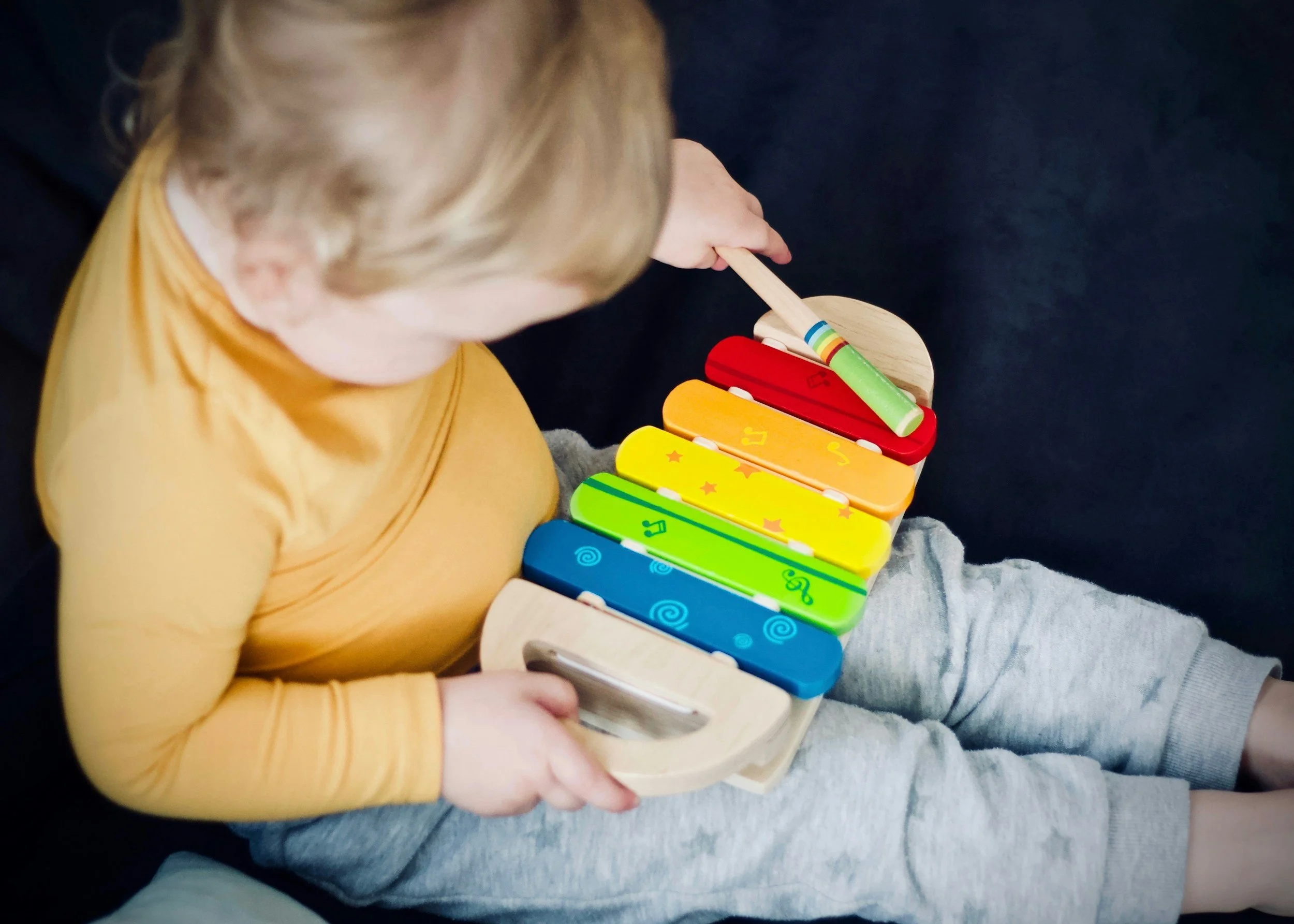
There’s a reason every culture on earth, going back as far as we can trace, sings to its babies. Long before a child can speak, they can feel a rhythm, settle into a lullaby, and light up at a familiar tune. Music isn’t a nice extra in early childhood. For a developing brain, it’s something closer to a nutrient.
As an avid musician and early childhood educator, this is science that resonates with me personally — so forgive me if I get a little starry-eyed. But you don’t have to take my word for it. Here’s what researchers have found about what music actually does for your little one.
Music and language grow up together
Here’s the finding that still gives us goosebumps: the parts of a child’s brain that process music and the parts that process language are deeply intertwined. When your child claps to a beat or fills in the last word of a song, they’re exercising the very same circuits they’ll use to read and speak (state-of-the-art review, 2023).
The connection is strongest in one beautiful place: rhythm. Researchers have found that young children with stronger rhythm skills tend to have stronger “phonological awareness” — the ability to hear and play with the individual sounds inside words, which is one of the best early predictors of reading (Politimou et al., 2019). In that same research, rhythm was the strongest musical predictor of phonological awareness, while melody best predicted early grammar.
And this isn’t only a matter of which children happen to be musical. When researchers gave three-year-olds structured musical activities, the children measurably improved across multiple areas of phonological awareness — including rhyming and breaking words into syllables (Cambridge Applied Psycholinguistics, 2016). In other words, music doesn’t just go along with language development. It appears to help build it.
QUICK SCIENCE: Why rhythm is a reading skill in disguise
To read, a child eventually has to hear that “cat” is made of three separate sounds — c-a-t. That’s phonological awareness. Clapping syllables, bouncing to a beat, and chanting rhymes are all secret rehearsals for exactly that skill. Every “ba-na-na” you clap out is early literacy in a party hat.
What’s happening inside the brain
Part of the reason music is so powerful is that it lights up the whole brain at once. When a word arrives wrapped in a song, a child’s auditory cortex processes the sound, the motor regions engage with the rhythm, and language centers handle the meaning — all together. That multi-area workout helps forge stronger, more connected neural pathways, which is part of why children so often remember information better when it’s set to music (quick — try to recall the alphabet without singing it. See?).
Even in infancy, the effects show up early. Babies regularly exposed to music show stronger neural processing of sound patterns, which supports phonetic discrimination — the building block of a growing vocabulary. It’s one of the most-studied inputs in all of early development.
THE MAILBOX MELODIES METHOD
Every choice in your child’s monthly Mailbox Melodies is built on this science. The repetition that toddlers crave (and that drives parents a little batty) is exactly how those sound patterns get wired in. The hand motions pair movement with melody to light up more of the brain. The themed, slow-paced songs give language a rhythmic home so it sticks. I didn’t choose music because it’s cute (well, maybe a little lol). I built this whole experience around what music does.
It’s not just about getting smarter
We want to be careful here, because music’s gift to your child is so much bigger than reading scores. Some of its most precious benefits never show up on any test.
Music is one of the earliest ways children learn to regulate their emotions. A slow, calm song can bring a wound-up toddler back down. An upbeat one can lift a flat morning. Over time, children who experience this begin to reach for music themselves as a tool for soothing and shifting their mood — a skill that serves them for life.
Music is also profoundly social. Singing together, taking turns, waiting for the chorus, moving in sync — these are tiny lessons in connection and self-control, wrapped in joy. And the simplest benefit of all: when you sing with your child, you are bonding. That shared gaze, that giggle at the silly verse, that snuggle during the lullaby. The neuroscience is wonderful, but the love is the whole point.
TRY THIS AT HOME
- Lean into repetition. Sing the same songs over and over. Your toddler isn’t bored — their brain is busy laying down pathways with every repeat.
- Add the body. Clap the syllables of their name. March, sway, tap. Pairing movement with music deepens the learning (and burns off some energy).
- Use music to shift the mood. A consistent wind-down song before nap or bed becomes a powerful, regulating cue over time.
- Narrate with rhythm. Make up little chants for daily routines — a cleanup song, a hand-washing song. Children remember what they sing.
- Sing badly and often. Your child does not care if you’re off-key. They care that it’s you. Your voice is their favorite instrument.
The gentle takeaway
When you expose your children to music, you’re doing something that looks simple and is anything but. You’re feeding language, wiring the brain for reading, teaching emotional regulation, and saying I love you in the oldest language we have. All at once. In a two-minute song.
That’s the quiet, daily magic I try to send to your mailbox each month — not because music is a luxury, but because for a growing child, it’s one of the most natural and powerful ways to learn there is. So press play, take their hands, and sing. Their brain is listening, and so is their heart. The monthly options for keeping new songs coming are compared in Best Music Subscriptions for Kids.
References
- The Association between Music and Language in Children: A State-of-the-Art Review (2023). PMC10216937
- Politimou, N., Dalla Bella, S., Farrugia, N., & Franco, F. (2019). Born to Speak and Sing: Musical Predictors of Language Development in Pre-schoolers. Frontiers in Psychology. Frontiers
- Music effects on phonological awareness development in 3-year-old children (2016). Applied Psycholinguistics, Cambridge University Press. Cambridge Core
- Tierney, A., & Kraus, N. Auditory Neuroscience Lab, Northwestern University — research linking rhythm skills and phonological/language ability. Overview: Brainvolts / Northwestern.
Questions Parents Ask About Music and Development
Does music really make my child smarter?
Not in the way the packaging on some products implies. The “classical music raises IQ” claim has not held up well. What research more consistently associates with music in early childhood is language, listening, and social development — smaller claims, better supported, and honestly more useful.
Do I need to play an instrument for this to work?
No. Singing to and with your child is the version that matters most in the early years, and it requires nothing you don’t already have. Instruments come later and are optional.
What if I can’t sing?
Then you’re in the majority of parents I taught, and it makes no difference to your child. They’re tracking your face, your timing, and your attention. Pitch accuracy is the least important variable in the room.
Is recorded music as good as live singing?
For young children, live usually wins — a person adjusts to a child in a way a recording can’t. But recorded music does real things a parent can’t do all day, and the two aren’t in competition. Use both.
At what age should we start?
Whenever you like; there’s no window that closes. Newborns respond to singing, and a six-year-old starting an instrument is not behind. The one thing worth doing early is making music something that simply happens in your house.

— Ms. Chelsea
Written by
Ms. Chelsea
Before starting Mailbox Melodies, Chelsea created Grape Jammers Music, a music education business in Napa, California, where she still teaches toddler music classes today. She has also taught preschool, is classically trained in voice, and has over 30 years of stage experience — including professional performances at Disneyland and SeaWorld. These days she writes and records the songs, draws the zines, and packs every envelope herself, and tries it all out on her own two little ones for inspiration.
Read Chelsea’s letter →How it works
Music class, delivered to your mailbox
Every month I write songs specifically for how young brains listen — slow, repetitive, and built to be sung along with.
Join
Sign up in under a minute, for your family or as a gift.
Ms. Chelsea gets to work
She writes and records the month’s songs and packs every envelope herself.
Watch the mailbox
Real mail arrives with your child’s name on it. Pop in the CD and music class begins at home.
$19 a month · ships on the 15th · cancel anytime
See How It WorksScreen-free music mail for developing minds.