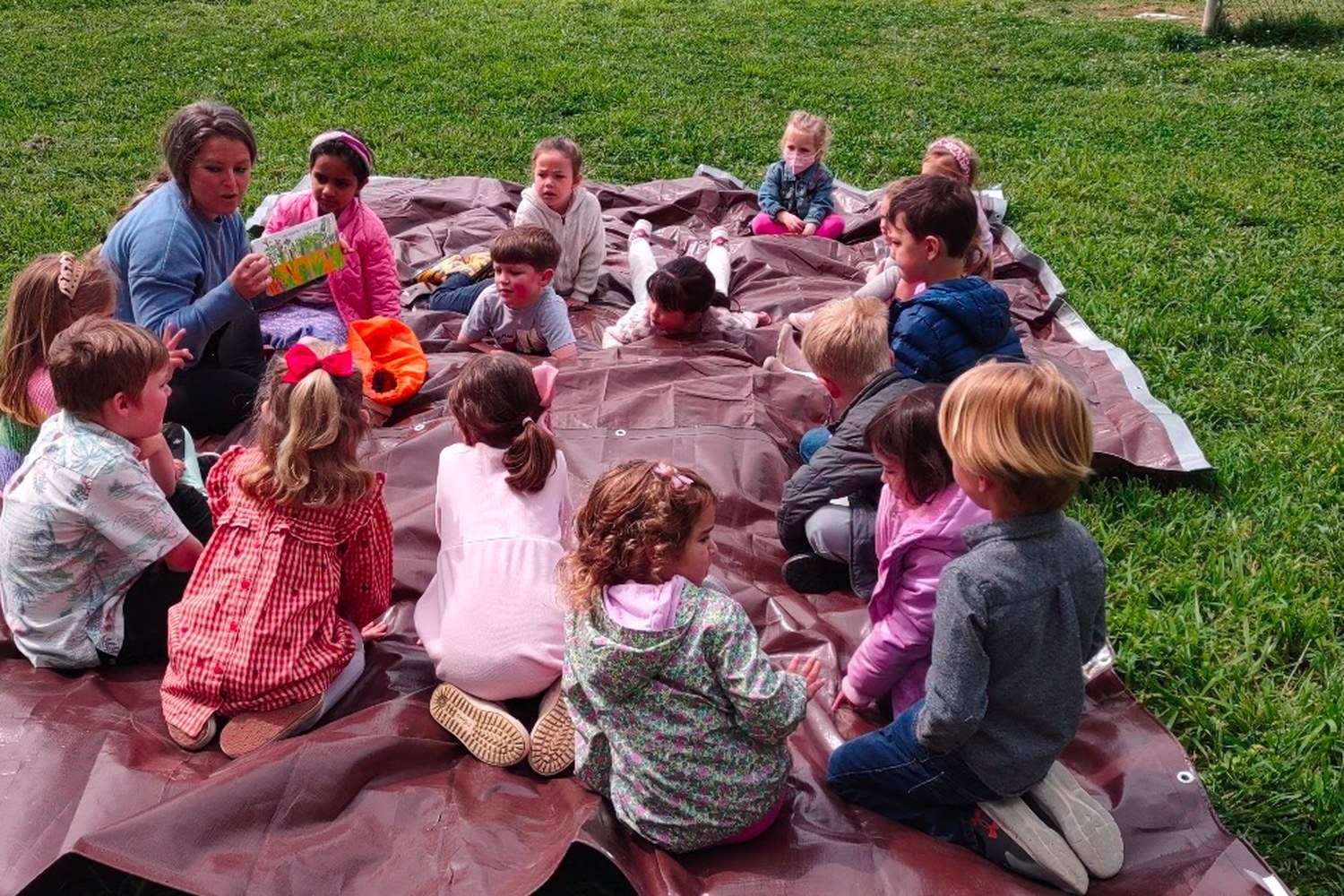
There’s a specific sound a group of five-year-olds makes that no younger group can. Everybody claps, and it lands together. Not perfectly — but together enough that the room suddenly has a pulse in it.
The first time it happened in a class I was teaching, I stopped and made them do it again, and they had no idea why I was so pleased. To them nothing remarkable had occurred. They had simply, finally, been able to do the thing.
Five is the year the beat shows up. Everything else about music at this age follows from that. (The full toddler guide maps the whole arc.)
Five Is When Timing Clicks
For four years your child has been responding to music. At five, many children start aligning with it — clapping, stepping, or tapping along with a steady pulse and staying there for a while.
This is worth knowing about because researchers have been paying attention to it. Studies have found that preschoolers’ ability to synchronize to a beat is associated with measures of how precisely their brains encode speech sounds, and with early reading-readiness skills.[1] The finding is correlational and I’d resist any leap to “drumming makes readers” — but the underlying idea is intuitive enough. Hearing where a beat falls and hearing where a syllable falls are close cousins.
The other thing that arrives at five is accuracy as a value. A four-year-old wants to be loud; a five-year-old wants to be right. They’ll ask you to sing it again properly. They’ll notice when a sibling comes in early. This is new, and it’s the beginning of caring about craft.
QUICK SCIENCE Beat-keeping is a physical skill before it’s a musical one. A child who can march in time will usually clap in time within a few months — the feet get there first, because they’re bigger and slower and easier to feel.
Songs and Games That Fit Five
Five-year-olds want a challenge with a clear success condition. Straight singalongs start to feel young; games do not.
Hand-clap games — Miss Mary Mack, A Sailor Went to Sea. This is the sweet spot age for these, and they are pure rhythm training disguised as a playground activity.
Boom Chicka Boom — a call-and-response echo song with different voices (underwater, robot, opera). It requires listening carefully and reproducing exactly, which is the skill of the year.
The Cup Song / any simple rhythm pattern — a repeating four-beat pattern with cups or hands. It’s hard enough to take a week to learn, which at five is the point.
Rounds — Row, Row, Row Your Boat or Frère Jacques — five is early for rounds and many children can just about manage one with an adult holding each part. Failing at a round is also fun, which helps.
I’ve Been Working on the Railroad — a long song with a real melody and words worth learning. Fives can hold a full song now, and they’re proud of it.
Freeze dance with a twist — stop the music and everyone freezes, but the rule changes each round (freeze low, freeze on one foot, freeze silently). Listening for the stop is the actual exercise.
Three Things to Try This Week
March the beat, don’t clap it. Put a song on and walk the pulse across the room together. If your child is struggling to clap in time, marching almost always works first.
Play the echo game. Clap a short pattern; they clap it back. Start with two beats, build to four. Get it wrong deliberately sometimes so being right feels earned.
Find the beat in a song they didn’t pick. Anything on the radio. Ask where the beat is, then nod it together. Five-year-olds are genuinely interested in the idea that all music has this hidden thing in it.
TRY THIS AT HOME Try a “same song, three speeds” challenge — sing something they know slowly, normally, then as fast as you both can manage without falling apart. Fives love the fast round and, unlike four-year-olds, will notice when the fast round loses the beat.
What You Can Skip
Skip babyish repertoire, mostly. Five-year-olds start noticing that some songs are “for little kids.” Keep the family favorites — they’ll still want those privately — but bring in longer, more grown-up songs for the shared repertoire.
Skip the metronome. A beat that never bends is much harder to join than a person who adjusts slightly. Human timing is the better teacher at this age.
Skip comparing to the child in class who plays violin. Some five-year-olds are two years into an instrument. It genuinely doesn’t predict much yet, and the comparison is more likely to cost your child their enthusiasm than to gain them anything.
And skip screens as the default filler. Five is old enough for real independent play, and a five-year-old with a shaker and a boring afternoon will invent something — there’s a whole list of what that can look like.
Where Mailbox Melodies Fits at Five
Five is the age where your child stops receiving the envelope and starts running the envelope.
They’ll get the mail themselves. They’ll open it themselves. They’ll read some of the zine themselves, and they’ll have a view on which track is best and which one is “for babies.” That last part is real, and it’s why what I write for five leans on rhythm games, longer songs, and things that take a couple of tries to get right. I still teach these classes, so I find out quickly which of those land and which don’t.
It’s also the age where the CD gets played without an adult starting it, which was one of the reasons I wanted a physical disc in there in the first place. Envelope ships on the 15th with their name on it — CD, zine, stickers, often a craft, plus a download code. $19 a month, shipping included, cancel anytime.
- Woodruff Carr, K., White-Schwoch, T., Tierney, A. T., Strait, D. L., & Kraus, N. (2014). Beat synchronization predicts neural speech encoding and reading readiness in preschoolers. Proceedings of the National Academy of Sciences.
Questions Parents Ask About Music at Five
My five-year-old still can’t clap in time. Should I worry?
No. Beat synchronization has a wide normal range and plenty of children get there closer to six or seven. Try marching instead of clapping — bigger movements are easier to align — and let it be a game rather than a test.
Is five a good age to start an instrument?
For many children, yes. Five-year-olds can usually manage a short daily practice and understand that improvement takes repetition. Piano and violin are common starts; ukulele is underrated and forgiving. What matters most is a teacher your child likes.
Does learning music actually help with reading?
Some research has found associations between beat-keeping ability, speech encoding, and early reading skills in preschoolers.[1] That’s a real and interesting finding, and it’s still a correlation — music is worth doing for its own sake, and any reading benefit is a bonus rather than the reason.
My child says our songs are babyish now. What do I do?
Take them seriously and level up the repertoire. Hand-clap games, rounds, and real folk songs with verses all feel older. The family songs won’t disappear; they’ll just move to bedtime.
What changes at six?
Words start doing more of the work — six is where rhyme, reading, and music start feeding each other.

— Ms. Chelsea
Written by
Ms. Chelsea
Before starting Mailbox Melodies, Chelsea created Grape Jammers Music, a music education business in Napa, California, where she still teaches toddler music classes today. She has also taught preschool, is classically trained in voice, and has over 30 years of stage experience — including professional performances at Disneyland and SeaWorld. These days she writes and records the songs, draws the zines, and packs every envelope herself, and tries it all out on her own two little ones for inspiration.
Read Chelsea’s letter →How it works
Music class, delivered to your mailbox
The songs in this article are the kind I write every month — and mail to your child with their name on the envelope.
Join
Sign up in under a minute, for your family or as a gift.
Ms. Chelsea gets to work
She writes and records the month’s songs and packs every envelope herself.
Watch the mailbox
Real mail arrives with your child’s name on it. Pop in the CD and music class begins at home.
$19 a month · ships on the 15th · cancel anytime
See How It WorksScreen-free music mail for developing minds.