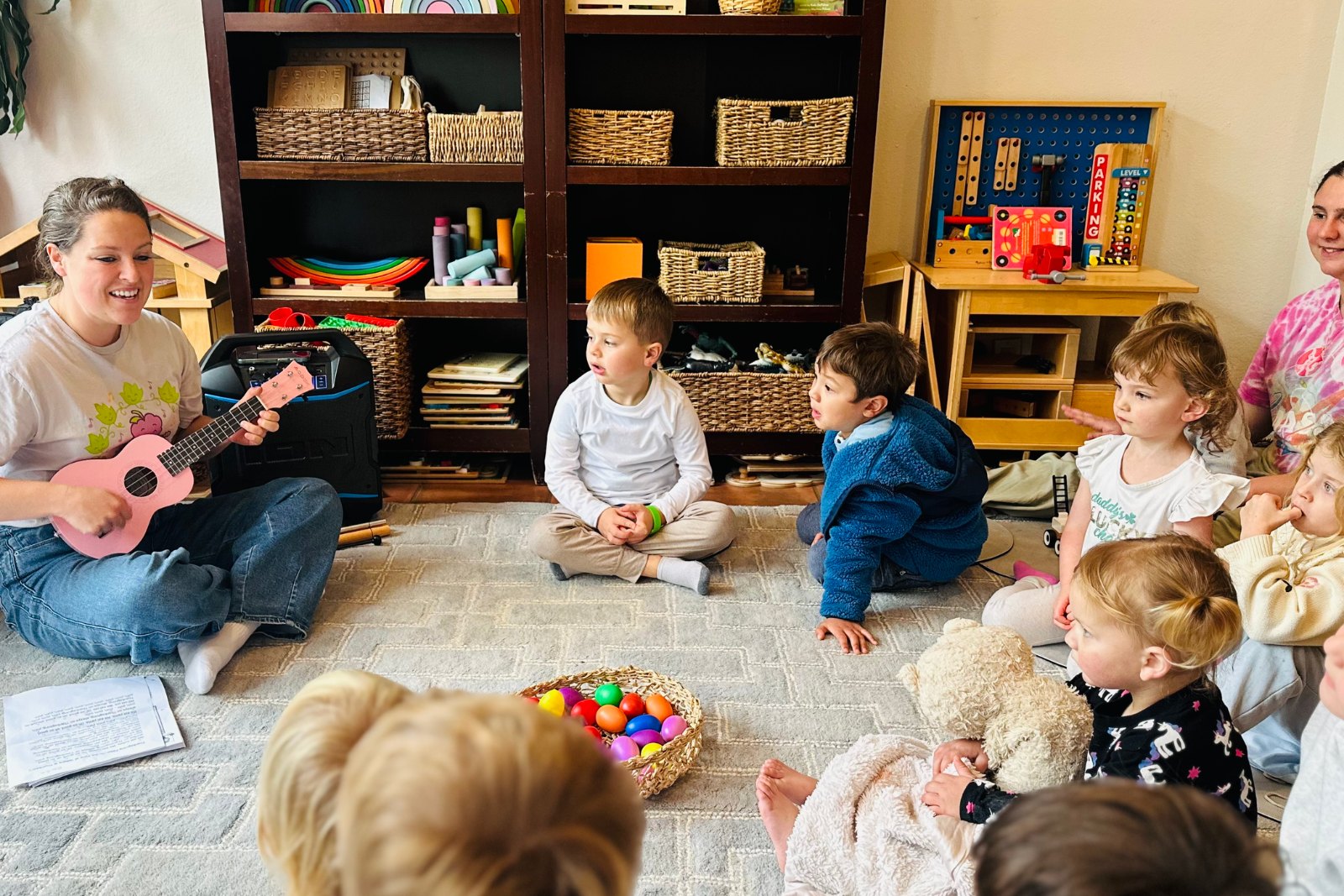
There is a moment in a class of two-year-olds that never gets old. Four weeks into a session singing the same Good Morning song, the one they’d heard so many times — and then it happens — one child, sitting slightly apart from everyone, would quietly sing the last word of a line. Not the whole line. Just the last word, landing exactly on the beat, weeks after they first heard it.
That’s two. Not performing, not on cue, not for anyone. Just the song finally coming back out of them.
If you have a two-year-old, you’re in the year music stops being something that happens to them and starts being something they do. (The full toddler guide maps the whole arc; this page is just the two-year-old stretch of it.) Here’s what that actually looks like, which songs are worth your time right now, and what you can safely ignore.
What’s Happening Musically at Two
Two is a listening year that turns into a singing year, usually somewhere in the middle.
At the start, most twos are still mostly moving. They bounce, they sway, they march — often with tremendous enthusiasm and almost no relationship to the actual beat. That’s normal and it stays normal for a while. Research on infant and toddler movement suggests that rhythmic engagement with music shows up very early, but that reliably matching an external beat comes much later.[1] Your two-year-old is not off-beat. They simply haven’t got the beat yet, and they’re not supposed to.
What does arrive at two is language, in a rush. Most children this age are combining two words, and vocabulary is expanding faster than at any point so far.[2] Songs slot straight into that. A song is language that holds still — same words, same order, same tune, every single time — which makes it unusually easy to grab hold of.
So the singing that appears at two is partial by design. They sing the last word of a line. Then the last two. Then the word they like best regardless of where it falls. This is not half-learning a song. This is learning a song, and it’s the same route every child takes.
QUICK SCIENCE A two-year-old will not sing in tune, and won’t for a good while yet — pitch-matching typically firms up closer to four or five. If your child sings enthusiastically and inaccurately, they’re doing it correctly.
If your little one only just turned two, the bouncing, whole-body response of the one-year-old year is still very much in play. If they’re closing in on three, you’ll start seeing the story-telling and pretending that shapes music at three.
Six Songs That Land at Two
The songs that work at this age all do one of two things: they leave a gap for your child to fill, or they attach the words to a movement.
Old MacDonald — the pause before the animal is the entire game. Sing “and on that farm he had a…” and then stop. Wait longer than feels comfortable. The gap is where your two-year-old gets to be the one who knows.
The Wheels on the Bus — the gestures arrive months before the words do. A two-year-old can do “round and round” long before they can sing it, and doing the motion while hearing the phrase is how the phrase gets learned.
Twinkle, Twinkle, Little Star — short phrases, a small range, and it ends on the note it started on. It’s one of the first songs many children can carry the shape of, even when the pitches wander.
If You’re Happy and You Know It — instruction-following wrapped in a song, with zero pressure attached. Nobody minds if they clap late, and everybody claps eventually.
The Ants Go Marching — a steady walking beat that fits a two-year-old’s body better than clapping does. Marching is easier than clapping at this age; feet are bigger and slower than hands.
Head, Shoulders, Knees and Toes — a body map and a tempo game in one. Sing it slowly, then sing it fast. The fast round is always the one they ask for again.
And they will ask again. And again, and again — there’s real brain science behind that, and it’s the reason I write repetition into every month deliberately rather than apologetically.
Three Things to Try This Week
The kitchen march. Put one song on while you’re making dinner and march the length of the kitchen and back. Don’t teach it. Just march, and let them fall in behind you. Two-year-olds follow bodies more readily than instructions.
The car pause. In the car, sing a song they know and drop out entirely for one word. Say nothing about it. Some days they’ll fill the gap, some days they won’t, and both are fine — but the day they do it unprompted is a genuinely good day.
Fast and slow. Take any song they already know and sing it at half speed, then at double speed. This is the closest thing to a tempo lesson a two-year-old can use, and it plays like a joke rather than a lesson. (The slow version is usually funnier than you’d expect.)
TRY THIS AT HOME Pick one song and make it the song of the week — same song, same moment, every day. Bath time, car seat, the walk to the door. The point isn’t variety; it’s the small confidence of knowing exactly what comes next.
What You Can Skip
Skip anything with flashing lights. A toy that lights up while it plays is asking your child to watch, and watching competes with listening.
Skip the pressure to perform. “Sing it for Grandma” is the fastest way to end a song. Twos sing sideways — while playing, while walking, while apparently ignoring you.
Skip worrying about tune. See above; it isn’t time yet.
And skip the milestone panic entirely. There is no musical benchmark a two-year-old is failing to hit. If your child moves to music and enjoys hearing it, that’s the whole assignment.
Where Mailbox Melodies Fits at Two
Two is, honestly, the age I had most in mind when I started mailing these envelopes.
A two-year-old can’t read a tracklist or ask for a specific song, but they can absolutely recognize an envelope with their own name on it — and they can learn that this particular envelope means music. On the 15th of every month I send a CD of songs I’ve written and recorded, a zine of things to do together, stickers, and often a craft. The stickers, at two, tend to end up on the coffee table. That’s a fair trade.
I still teach toddler classes every week, which means every song gets road-tested on actual two-year-olds before it goes in an envelope. What the month gives you is the thing that’s genuinely hard to build on your own: a small set of songs, heard often enough to be learned properly, without you having to decide what to play. $19 a month, shipping included, cancel whenever you like.
- Zentner, M., & Eerola, T. (2010). Rhythmic engagement with music in infancy. Proceedings of the National Academy of Sciences.
- Centers for Disease Control and Prevention — Important Milestones: Your Child by Two Years.
- Gerry, D., Unrau, A., & Trainor, L. J. (2012). Active music classes in infancy enhance musical, communicative and social development. Developmental Science.
Questions Parents Ask About Music at Two
My two-year-old doesn’t sing at all. Should I be worried?
Almost certainly not. Plenty of children take in songs for months without producing any of them, then start singing in fairly complete phrases seemingly overnight. What matters more than singing is response — do they move, settle, or perk up when music starts? If your child isn’t responding to sound at all, that’s a conversation for your pediatrician, but silence during songs on its own is common.
How much music is too much in a day?
There isn’t a limit worth policing, but there is such a thing as music becoming wallpaper. Background music all day tends to get tuned out. Short, intentional bursts — a song at breakfast, a song in the car, a song at bath — do more than a playlist running for six hours.
Should I be using music apps or videos?
I’d point away from screens here, though not out of severity. The reason is specific: a two-year-old learns a song by watching your face and moving their own body, and a screen quietly replaces both. Audio without a picture keeps their eyes free.
Do music classes help at this age?
Some research suggests that active, participatory music classes in the early years are associated with gains in communication and social development.[3] I’ve taught those classes for several years and still do, and I’ve seen a version of it. But the effect people notice isn’t the class itself — it’s the singing that keeps happening at home between classes, which you can do without enrolling in anything.
Is it bad that they only want one song?
No, and it’s the single most common question I ever got. A two-year-old who has locked onto one song is doing focused work on it. They’ll drop it when they’re finished, usually abruptly, and often the week after you finally learn all the words. If you want to know what replaces it, three is when songs start having plots.

— Ms. Chelsea
Written by
Ms. Chelsea
Before starting Mailbox Melodies, Chelsea created Grape Jammers Music, a music education business in Napa, California, where she still teaches toddler music classes today. She has also taught preschool, is classically trained in voice, and has over 30 years of stage experience — including professional performances at Disneyland and SeaWorld. These days she writes and records the songs, draws the zines, and packs every envelope herself, and tries it all out on her own two little ones for inspiration.
Read Chelsea’s letter →How it works
Music class, delivered to your mailbox
The songs in this article are the kind I write every month — and mail to your child with their name on the envelope.
Join
Sign up in under a minute, for your family or as a gift.
Ms. Chelsea gets to work
She writes and records the month’s songs and packs every envelope herself.
Watch the mailbox
Real mail arrives with your child’s name on it. Pop in the CD and music class begins at home.
$19 a month · ships on the 15th · cancel anytime
See How It WorksScreen-free music mail for developing minds.