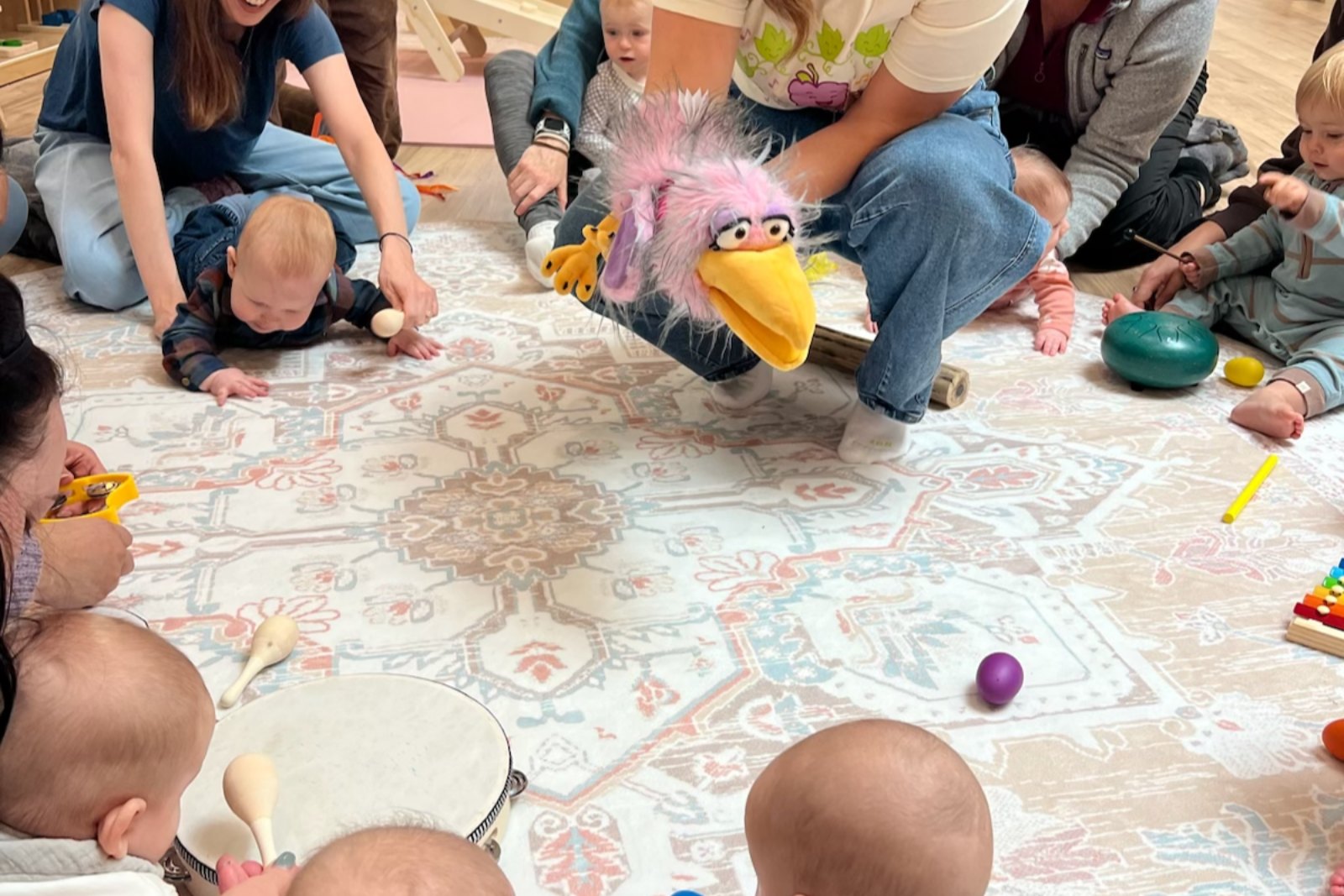
The first time I brought a class of babies and their parents into a room together, I made a mistake. I’d planned it like a toddler class — songs with actions, a beginning and an end, things to do. Ten minutes in, the babies were overwhelmed, reaching for their parents, seeking calmness and comfort. It was sensory overload — too much for them to handle.
So I stopped and did the only thing left. I sang one quiet song, slowly, looking at each baby in turn. Every single head swung around.
That’s the whole lesson of the first year, and it took me a room full of unimpressed infants to learn it. Babies don’t need music activities. They need to watch a person they love make sound at them. Everything else in this article is a footnote to that.
What a Baby Is Actually Doing While You Sing
More than it looks like.
Babies come out already tuned to voices, and to singing in particular. Research on infant-directed singing suggests that babies attend to sung speech differently than spoken speech, and that live singing is unusually effective at holding an infant’s attention and keeping them calm.[1] The reason isn’t mysterious. Singing is slower than talking, more repetitive, more exaggerated in pitch, and it comes with a face doing something interesting. It’s speech with the difficulty turned down.
What you’ll see, roughly in order across the first year: stilling — the whole body going quiet when a song starts. Then watching your mouth. Then, somewhere in the middle of the year, moving — a leg kick, a bounce, an arm that pumps when the music does. Research suggests rhythmic movement in response to music shows up remarkably early, well before anything you could call keeping time.[2] Then, late in the year, sound: a hum, a vowel held long, sometimes shaped a little like the tune.
None of it is on a schedule you should be tracking. What you can count on is that a baby who is watched and sung to is doing the work, whether or not anything comes out.
QUICK SCIENCE Your live, imperfect voice outperforms a recording for holding a baby’s attention. The tuning is not the point — the face, the timing, and the fact that you adjust to them is the point. (A recording can’t slow down because your baby yawned.)
Four Songs Worth Actually Learning
You need fewer songs than you think. Four that you know cold beat twenty you half-remember, because the ones you know are the ones you’ll sing when you’re exhausted at 4am — which is when it counts.
Twinkle, Twinkle, Little Star — small range, short phrases, and it resolves. It’s the one most adults can sing without thinking, which is exactly its value.
You Are My Sunshine — slow, low, and the melody moves in steps rather than leaps, so it’s easy on a tired voice. It’s also long enough to cover an entire diaper change.
Row, Row, Row Your Boat — a rocking rhythm that syncs with the motion you’re probably already doing. Babies who are being moved while sung to are getting two channels of the same information.
The Itsy Bitsy Spider — the first song where a baby starts to anticipate. Around eight or nine months you’ll notice them watching your hands before the spider climbs. That anticipation is the beginning of knowing a song.
Add a made-up song about what you’re doing right now. “Now we’re changing your diaper, now we’re changing your diaper” to any tune at all. It sounds ridiculous and it is one of the most useful things you can do — narration set to music, which is how a lot of early language arrives.

Three Things to Try This Week
Sing at a distance of about a foot. Close enough that your face is in focus. Newborn vision is blurry beyond a short range, so a song sung from across the room is missing half of itself.
Use one song as a signal. Same song, every time, at the same moment — the one before naps, or the one in the car seat. You’re not teaching the song. You’re building a small piece of predictability into a day that has almost none.
Leave a gap. Late in the first year, sing a familiar line and stop before the last word. Watch their face. Long before they can fill the gap, you’ll see them notice it’s missing — and noticing is the whole skill.
TRY THIS AT HOME Pick one song and attach it to one moment this week. Bath, car seat, the walk to the crib. Don’t add a second song until the first one feels automatic to you. Repetition is doing the work here, not variety.
What You Can Skip
Skip anything sold as making your baby smarter. The “classical music raises IQ” idea has been picked over for thirty years and doesn’t hold up the way the packaging implies. Play classical music because you like it, which is a perfectly good reason.
Skip the screens. Not out of severity — there’s a more specific reason. A baby learns a song by watching a face that responds to them. A screen has a face and no response, and in the first year that difference is most of the point.
Skip volume. Infant ears are more sensitive than yours. If you’d call it “background music” at a restaurant, it’s about right.
And skip the guilt entirely if you don’t sing. Plenty of adults were told at some point that they can’t. Your baby has no opinion about your pitch and never will.
Where Mailbox Melodies Fits With a Baby
I’ll be honest about this one, because babies are the age where a subscription is least obviously necessary: in the first year, the envelope is mostly for you.
Your baby will chew the sticker sheet. They will not do the craft. What they will get is a set of slow, repetitive, deliberately simple songs that you learn — and a baby whose parent knows four songs by heart is meaningfully better off than a baby whose parent is scrolling for something to play.
Every song goes through a room of real babies in my classes before it ever goes in an envelope, which is a quality check I’d struggle to get any other way. The zine each month has the words, so you’re not guessing. The CD is there for the car and the kitchen, and there’s a digital code if a disc isn’t practical. On the 15th of every month it goes out with your child’s name on the envelope, which matters more in year two than year one — but the songs start working immediately. $19 a month, shipping included, cancel whenever.
- Trehub, S. E., & Trainor, L. (1998). Singing to infants: Lullabies and play songs. Advances in Infancy Research.
- Zentner, M., & Eerola, T. (2010). Rhythmic engagement with music in infancy. Proceedings of the National Academy of Sciences.
Questions Parents Ask About Music and Babies
Can my baby actually hear music before they’re born?
Hearing develops in the third trimester, and some research suggests newborns show recognition of melodies and voices heard prenatally. It’s a lovely finding and I’d hold it lightly — it’s not a reason to put headphones on a bump, and no study supports doing that.
Is it bad that I only ever sing the same song?
It’s the opposite of bad. A song your baby has heard two hundred times is a song they can predict, and prediction is the entire developmental job of the first year. Novelty is for you, not for them.
What if I’m genuinely tone-deaf?
True tone-deafness (amusia) is rare — most people who say this were told once, as a child, by someone unkind. Either way it doesn’t matter here. Your baby is tracking your face, your timing, and your attention, none of which require accurate pitch.
Should I use a white noise machine or lullabies at bedtime?
Different jobs. White noise masks household sound; a lullaby is an interaction. If sleep is the goal, many families use both — a song at the crib and noise after. What I’d avoid is a music player running all night, which turns music into wallpaper.
When will my baby start singing back?
Usually not in the first year. Vowel-ish humming shows up for some babies around ten to twelve months, actual words in songs closer to two. If you want to know what’s coming next, the one-year-old year is where the body joins in — and the full toddler guide maps the whole arc.
— Ms. Chelsea
Written by
Ms. Chelsea
Before starting Mailbox Melodies, Chelsea created Grape Jammers Music, a music education business in Napa, California, where she still teaches toddler music classes today. She has also taught preschool, is classically trained in voice, and has over 30 years of stage experience — including professional performances at Disneyland and SeaWorld. These days she writes and records the songs, draws the zines, and packs every envelope herself, and tries it all out on her own two little ones for inspiration.
Read Chelsea’s letter →How it works
Music class, delivered to your mailbox
The songs in this article are the kind I write every month — and mail to your child with their name on the envelope.
Join
Sign up in under a minute, for your family or as a gift.
Ms. Chelsea gets to work
She writes and records the month’s songs and packs every envelope herself.
Watch the mailbox
Real mail arrives with your child’s name on it. Pop in the CD and music class begins at home.
$19 a month · ships on the 15th · cancel anytime
See How It WorksScreen-free music mail for developing minds.