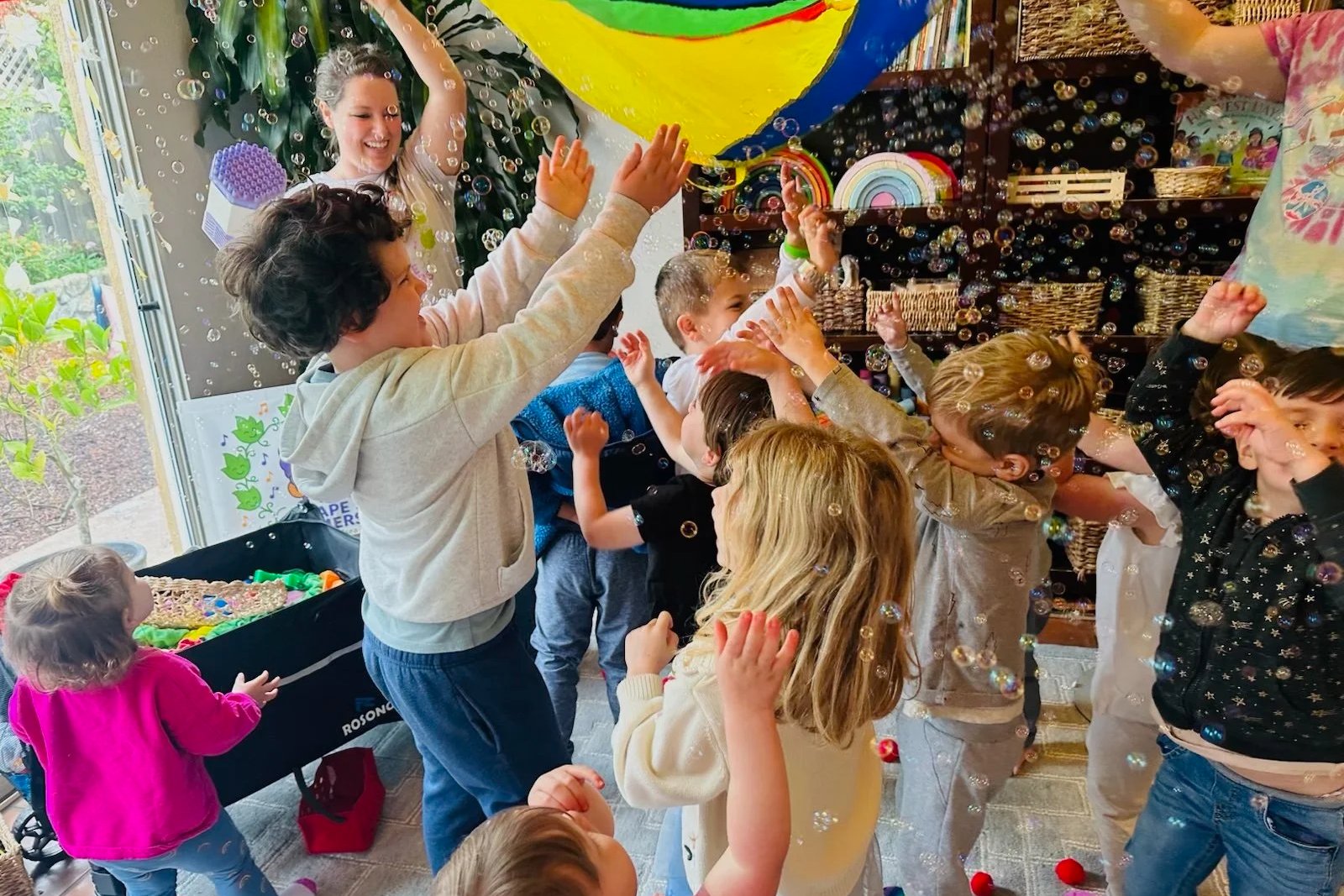
Some of you may know that the inspiration for starting Mailbox Melodies was teaching my in person toddler music classes in Napa called Grape Jammers Music (shout out to all that have attended!). Every week, a room full of little people shaking eggs, banging drums, and belting out songs at volumes that defy their tiny lungs. And every week, at least one parent pulls me aside afterward with a version of the same question: “What should we be doing at home?”
Usually there was a worried follow-up right behind it. “I can’t carry a tune.” “We don’t own any instruments.” “I don’t know any kids’ songs except the one about the bus.”
This guide is my long answer to that question. The short answer is simpler than you might hope: sing to your child, sing with your child, and let them make some noise. Everything below is just detail. You already have everything you need.
Why Music Matters So Much Before Age Five
The first five years are when the brain builds its basic wiring for language, attention, and connection, and music happens to exercise all three at once.
When researchers at the University of Washington gave 9-month-old babies a month of playful, active music sessions, the babies showed stronger neural responses to patterns in both music and speech compared to babies who had regular playtime without music (Zhao & Kuhl, 2016). The rhythm skills and the language skills seem to travel together, because spoken language is rhythmic too. Anyone who has said “all DONE, time for BATH” to a toddler has used rhythm to be understood.
Here’s the detail I find most encouraging as a teacher: how children experience music matters more than how much. A study at McMaster University compared one-year-olds in active music classes, where babies and parents sang, moved, and played together, with babies who simply heard recorded music in the background while they played. The active group showed earlier communication skills, more smiling, and easier soothing (Gerry, Unrau & Trainor, 2012). Music worked best as something families did, not something that merely played near them.
QUICK SCIENCE: In a large Australian study that followed thousands of families, shared music activities at home at ages 2–3, like singing and playing together, were associated with better vocabulary, attention, and social skills two years later, even after accounting for shared book reading (Williams et al., 2015). Not lessons. Not talent. Just singing together in the living room.
I want to be honest about what this research says and doesn’t say. None of these studies proves that music makes children smarter, and you should be suspicious of anyone who tells you otherwise. What the research suggests, consistently, is that shared musical experiences are associated with stronger early language, attention, and social development. For something this free and this fun, that’s plenty. If you’d like a deeper look at the science, I wrote a whole article on what music does for a developing brain.
Your Voice Is the Best Instrument in the House
Somewhere along the way, a lot of us decided that singing is a performance skill we either have or don’t have. Toddlers hold no such opinion. To your child, your voice is simply the most interesting sound in the world, because it belongs to you.
Your child has been listening to your voice since before they were born. When you sing, they aren’t grading your pitch. They’re getting your full attention, your face up close, and language slowed down and made musical. That combination is exactly what young brains feed on.
So if you take one thing from this guide, take this: an off-key parent singing “Twinkle, Twinkle” at bath time is doing more for their child’s development than the most beautifully produced recording playing in another room. Recordings are wonderful, and I make them for a living. They work best as a springboard for singing together, not a substitute for it.
What Music Looks Like at Each Age
Children don’t need us to teach them to be musical. They need us to notice the musicality that’s already there and join in. Here’s roughly what to expect, and what to do, at each stage.
Babies (0 to 12 months)
Babies are listeners first. They startle at sounds, calm to lullabies, and quickly learn to recognize the songs you repeat. Researchers have found that singing holds a baby’s attention and keeps them content longer than speech does, which will surprise no parent who has resorted to singing the weather report at 2 a.m.
What to do: sing during everyday care. Diaper changes, feeding, rocking. Pick two or three songs and repeat them until they’re familiar friends. Bounce gently to the beat while you hold your baby, because feeling rhythm in their body is how they first learn it.
Young Toddlers (1 to 2 years)
This is the age of the bounce. Play something with a strong beat and a one-year-old will bob, sway, and squat-dance with total commitment. They start requesting songs before they can name them, often by doing the hand motions and looking at you expectantly.
What to do: follow the requests, even the fiftieth one. Repetition is how toddlers learn, and I mean that literally enough that I wrote an entire article about why toddlers want the same song 100 times. Add simple instruments: a shaker, a small drum, a pot and a wooden spoon.
Older Toddlers (2 to 3 years)
Now the singing starts. First the last word of each line, then whole phrases, then entire songs with delightfully wrong lyrics. Two-year-olds begin to keep a steadier beat, love songs with actions, and start using music on their own, singing to their stuffed animals or humming while they play.
What to do: leave gaps. Sing “Twinkle, twinkle, little…” and wait. That pause, where your child fills in “star,” is them practicing memory, vocabulary, and timing all at once. Songs with movements, like “Head, Shoulders, Knees and Toes,” connect words to their meanings through the body.
Preschoolers (3 to 5 years)
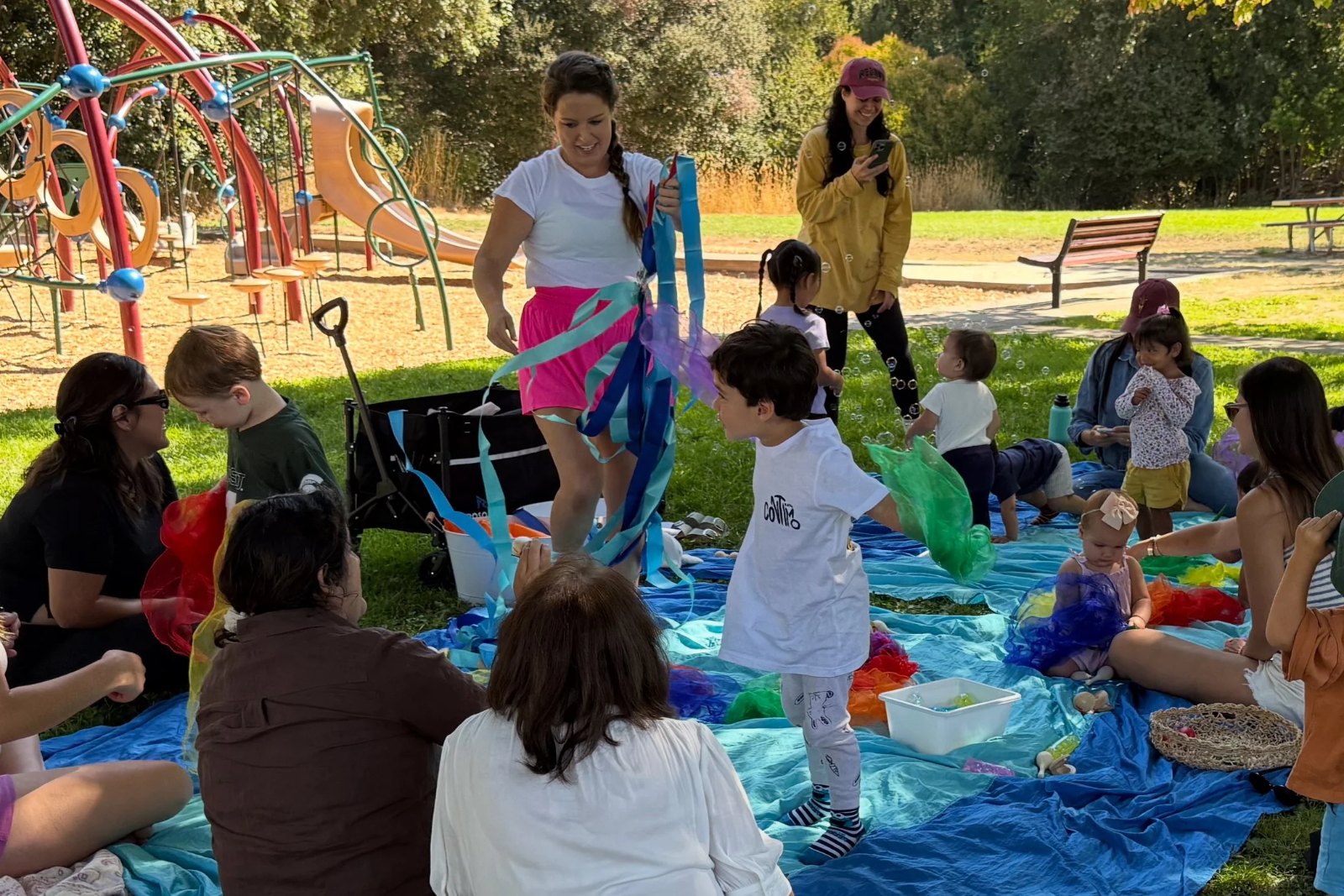
Preschoolers become music makers in their own right. They invent songs about what they’re doing, keep a beat well enough to march to it, and love silly rhymes and made-up verses. This is also when music becomes social: singing in a group, taking turns on a drum, moving together.
What to do: make up songs together. Change the words to familiar tunes. Let them perform for you, and be a warm audience. Group music matters here too: in one well-known study, 4-year-olds who made music together were more likely to spontaneously help and cooperate with each other afterward than children who did the same activity without music (Kirschner & Tomasello, 2010).
TRY THIS AT HOME: Pick one daily moment, cleanup, teeth brushing, or getting in the car seat, and give it a song this week. It can be two lines long and borrowed from any tune you know. “This is the way we brush our teeth” has served generations for a reason. By day three, the song will start the job for you.
Weave Music Into the Day You Already Have
The biggest myth about music for toddlers is that it requires a dedicated activity: a class, a lesson, a special block on the schedule. Classes are lovely. But the music that shapes a childhood mostly happens in the cracks of ordinary days.
Think about how naturally other family rhythms work: dinner, then dessert, then bath, then bed. Children relax into sequences they can predict. Songs slot beautifully into those sequences, because a song is itself a predictable sequence, with a beginning, a middle, and an end a child can feel coming. A cleanup song tells a two-year-old what’s happening and how long it will last better than any explanation. A quiet lullaby signals that the day is winding down. If predictability is a topic you’re curious about, my article on the magic of routines goes deeper.
Some easy anchors, none of which add a single minute to your day: a good-morning song while opening the curtains, a driving song for the car, a stirring song while you bake cookies together, a bath song, and one steady lullaby that ends every day the same way.
That last one deserves a special word. A lullaby sung by a parent, the same one, night after night, becomes a signal of safety that a child carries for years. It’s a small act of connection that costs nothing and means everything.
Instruments, Players, and What You Actually Need
Walk down any toy aisle and you’ll find shelves of flashing, beeping “musical” toys. Most of them make sound at children rather than inviting children to make sound themselves. You can skip nearly all of it.
A toddler’s ideal instrument collection is short: something to shake, something to tap, and something that jingles. Shaker eggs, a small drum or an upturned pot, and a wrist bell cover the whole territory for under twenty dollars. The instrument is just an excuse to keep the beat together, close to you.
For listening, I’m a fan of anything that lets a child put music on without a screen: a simple CD player they can learn to work themselves, or a screen-free audio player. If you’re weighing those options, I compared the two big ones in my honest Yoto vs Toniebox review. Screen-free matters here, because music apps and videos tend to turn an active, whole-body experience into passive watching. The research above found the benefits in the doing: the singing, moving, turn-taking versions of music. If you’re building a bigger toolkit of no-battery ideas, my list of 50 screen-free activities for toddlers is a good companion to this guide.
THE MAILBOX MELODIES METHOD: This research is why every Mailbox Melodies envelope is built around doing music, not just hearing it. Each month’s CD is recorded so parents can actually sing along, in comfortable keys, at toddler-friendly tempos, and the zine shows you the motions and activities that go with each track. The stickers and crafts pull little hands into the experience. It ships on the 15th of every month, and the ritual of checking the mailbox is part of the fun: real anticipation, for a real object, that you explore together.
When Music Helps With Hard Moments
A quick word for the tired parent in the trenches: music is also a practical tool for the hardest parts of toddlerhood.
Transitions, leaving the park, ending bath time, are where toddlers fall apart, because stopping something good is genuinely hard when you’re two. A transition song works like a friendly countdown. It gives the change a shape, and because the song always ends the same way, your child knows what comes next without a negotiation.
Big feelings respond to music too. Singing slowly and quietly while you hold an upset child gives both of you something steady to breathe along with. I say “both of you” deliberately. Plenty of parents have sung “You Are My Sunshine” in a dim nursery as much for their own nerves as for the baby’s. It counts for both.
Where to Start This Week
If this guide feels like a lot, let it shrink back down to the short answer: sing to your child, sing with your child, let them make some noise.
Start with three songs. One for morning, one for play, one for bedtime. Sing them every day for two weeks, and watch what your child starts to do with them: the requests, the fill-in-the-blank pauses, the hand motions, the humming from the back seat. That’s musical development happening in plain sight, and you did it without a single flashcard, app, or lesson.
Your voice, their giggle, a shaker egg. That’s the whole method.
- Zhao, T. C., & Kuhl, P. K. (2016). Musical intervention enhances infants’ neural processing of temporal structure in music and speech. Proceedings of the National Academy of Sciences, 113(19), 5212–5217. https://www.pnas.org/doi/10.1073/pnas.1603984113
- Gerry, D., Unrau, A., & Trainor, L. J. (2012). Active music classes in infancy enhance musical, communicative and social development. Developmental Science, 15(3), 398–407. https://onlinelibrary.wiley.com/doi/abs/10.1111/j.1467-7687.2012.01142.x
- Williams, K. E., Barrett, M. S., Welch, G. F., Abad, V., & Broughton, M. (2015). Associations between early shared music activities in the home and later child outcomes: Findings from the Longitudinal Study of Australian Children. Early Childhood Research Quarterly, 31, 113–124. https://www.sciencedirect.com/science/article/abs/pii/S0885200615000058
- Kirschner, S., & Tomasello, M. (2010). Joint music making promotes prosocial behavior in 4-year-old children. Evolution and Human Behavior, 31(5), 354–364. https://www.sciencedirect.com/science/article/abs/pii/S1090513810000462
Questions Parents Ask About Music and Toddlers
What kind of music is best for toddlers?
Slow, repetitive, and simple beats clever every time. A toddler is learning to predict what comes next, so a song with a small range, a steady tempo, and words that land in the same place each time is doing far more work than something busy. Traditional songs survived for a reason — they were shaped by generations of children.
How much music should we do in a day?
Less than you would think, done properly. Three or four songs attached to real moments — waking, the car, bath, bed — do more than a playlist running all afternoon. Music that never stops becomes wallpaper, and a toddler learns to tune it out.
Does my toddler need music lessons?
No. Some research associates active, participatory music classes with gains in communication and social development, and I still teach those classes every week — but the benefit lives in the singing that keeps happening at home between classes, which costs nothing and needs no enrolment.
What if I can’t sing?
Then you are in the majority of the parents I have taught, and it makes no difference to your child. They are tracking your face, your timing, and your attention. Pitch accuracy is the least important variable in the room, and your imperfect live voice beats any recording for holding a small child’s attention.
Are music apps and videos okay?
I would point away from screens here, for a specific reason rather than out of severity: a toddler learns a song by watching your face and moving their own body, and a screen quietly replaces both. Audio without a picture keeps their eyes and hands free, which is most of the reason I mail a CD rather than a login.

— Ms. Chelsea
Written by
Ms. Chelsea
Before starting Mailbox Melodies, Chelsea created Grape Jammers Music, a music education business in Napa, California, where she still teaches toddler music classes today. She has also taught preschool, is classically trained in voice, and has over 30 years of stage experience — including professional performances at Disneyland and SeaWorld. These days she writes and records the songs, draws the zines, and packs every envelope herself, and tries it all out on her own two little ones for inspiration.
Read Chelsea’s letter →How it works
Music class, delivered to your mailbox
Everything in this guide is what I put into the envelope every month — songs written for how toddlers actually listen.
Join
Sign up in under a minute, for your family or as a gift.
Ms. Chelsea gets to work
She writes and records the month’s songs and packs every envelope herself.
Watch the mailbox
Real mail arrives with your child’s name on it. Pop in the CD and music class begins at home.
$19 a month · ships on the 15th · cancel anytime
See How It WorksScreen-free music mail for developing minds.