

If you’ve ever watched your little one melt into a puddle because they wanted the cookie right now, you already know something researchers have spent fifty years studying: waiting is hard. It’s especially hard for small humans whose brains are still very much under construction — the part that helps us wait is one of the last to come fully online, which explains… a lot.
But here’s the good news, and the reason this topic is so close to my heart. The ability to wait — what psychologists call delayed gratification — isn’t a fixed trait your child either has or doesn’t. It’s a skill. And like every skill we talk about here, it’s one you can gently nurture, a little at a time, through the calm routines of everyday life.
What delayed gratification really is
Delayed gratification is simply the ability to pass up a small reward now in favor of a bigger or better reward later. Choosing to wait for the second marshmallow. Saving the last bite for after dinner. Sitting through one more page before the song starts.
Underneath that small act of patience is something much bigger: self-regulation. It’s the same muscle your child uses to take a deep breath instead of throwing the toy, to listen instead of interrupting, to keep trying when a puzzle is tricky. Researchers group these abilities under “executive function” — the mental skills that help us focus, manage feelings, and reach a goal. They form the foundation for so much of what comes later, from making friends to sitting in a kindergarten circle.
The famous marshmallow study — and what we’ve learned since
You may have heard of the “marshmallow test.” In the early 1970s, Stanford psychologist Walter Mischel sat preschoolers down with a single marshmallow and a deal: wait fifteen minutes without eating it, and you’ll get two. Years later, the children who had waited longest seemed to be doing better in all sorts of ways.
It became one of the most famous studies in psychology. But here’s the part we love telling parents, because it takes the pressure off: more recent research has added important nuance. A large 2018 replication found that once you account for a child’s home environment and family background, the link between waiting at age four and later achievement gets much smaller (Watts, Duncan & Quan, 2018). And a 2024 study concluded the test does not reliably predict how a child turns out as an adult (see references).
In other words: if your two-year-old grabs the cookie, please don’t read it as a sign of their future. The science simply doesn’t work that way. What the marshmallow studies did beautifully reveal is how children manage to wait — and that’s where the encouragement lives.
THE MAILBOX MELODIES METHOD
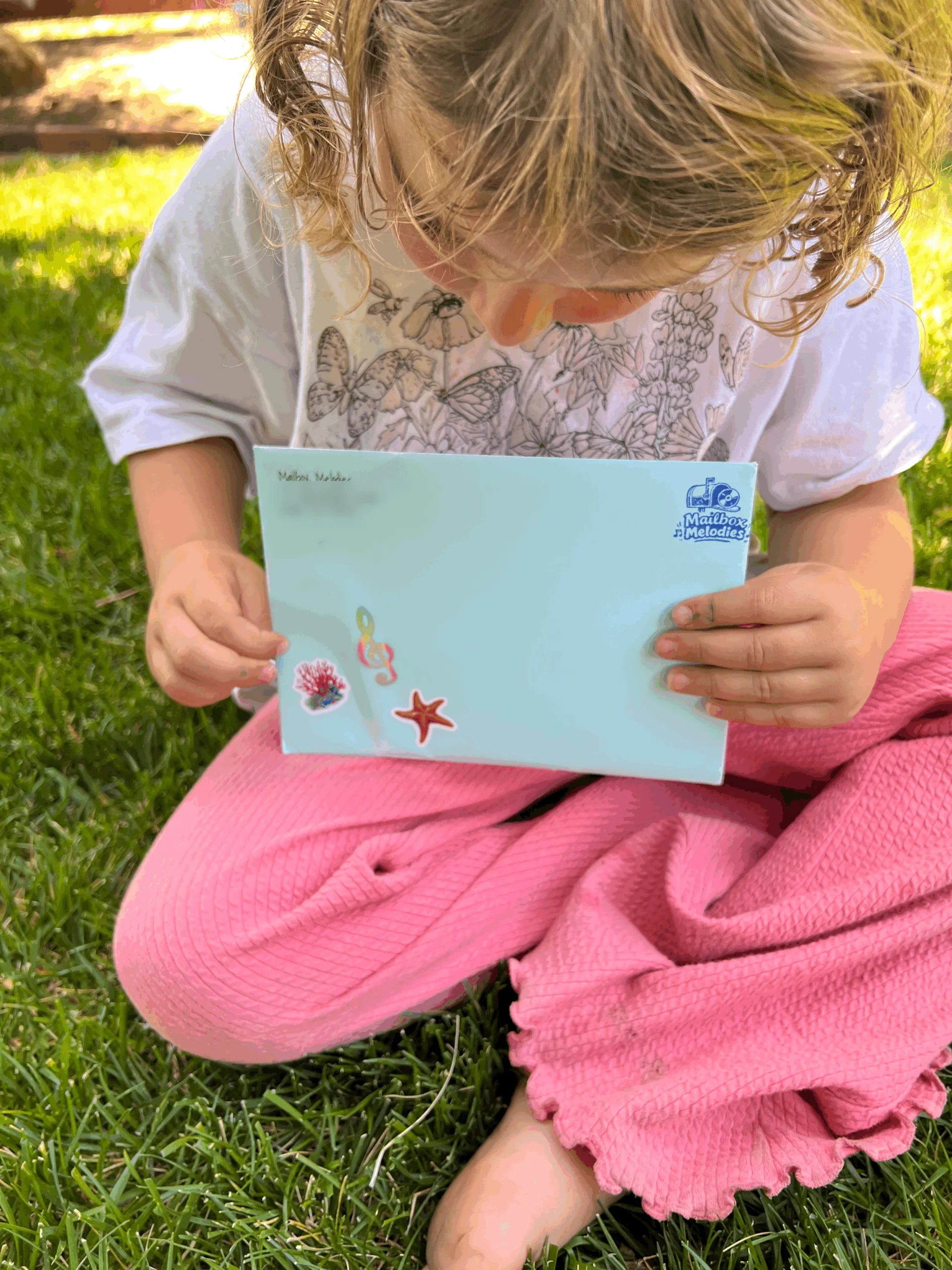
The wait is the magic. Every month, your child’s Mailbox Melodies ships on the 15th — a little package of anticipation they can look forward to. That gentle, predictable wait, followed by a delivery that always shows up, is delayed gratification in its most joyful form. The looking-forward is part of the gift.
Waiting is partly about trust
One of our favorite studies flips the whole conversation. In 2013, researchers at the University of Rochester gave children a marshmallow-style challenge — but first, they showed each child either a reliable adult (one who kept their promises) or an unreliable one (who didn’t). The children who had learned the adult was trustworthy waited up to four times longer (Kidd, Palmeri & Aslin, 2013).
Sit with that for a moment. The “patient” children weren’t simply born with more willpower. They had good reason to believe that waiting would pay off. For a young child, choosing to wait is actually a smart, rational bet — but only when the world has shown them it’s a safe one.
This is wonderful news, because it means one of the most powerful things you can do is simply be predictable. When you say “after this song, we’ll have a snack” and then you follow through, you’re not just keeping a small promise. You’re teaching your child that the world is reliable, and that waiting is worth it.
Gentle ways to build the waiting muscle
Patience grows in tiny, everyday moments — no flashcards required. The goal isn’t to make waiting harder; it’s to make it feel safe, playful, and doable.
TRY THIS AT HOME
- Name the wait, then fill it. “We’re waiting for the muffins to cool. Let’s sing our counting song while we wait!” A song turns empty waiting into something cozy.
- Use ‘first, then.’ “First we tidy the blocks, then we read.” Simple, predictable sequences help little brains hold onto a goal.
- Play waiting games. Take turns. Freeze and “smell the flowers” with a big slow breath. Blow up an imaginary balloon together, slowly. These build self-regulation through play.
- Always follow through. If you promise the second marshmallow, deliver it. Reliability is the lesson underneath the lesson.
- Keep expectations age-sized. A two-year-old who waits thirty seconds is doing real work (thirty seconds is basically an eternity in toddler time). Celebrate the small wins.
The gentle takeaway
Delayed gratification isn’t about raising a child who never wants things now. (That child does not exist, and honestly, how boring would they be?) It’s about slowly, lovingly helping your little one discover that they can sit with a feeling, trust that good things come, and find calm in the in-between.
It’s the same quiet skill I weave into every Mailbox Melodies delivery — the transition songs, the wind-down routines, the big slow breaths. Patience, it turns out, is something we practice together. One song, one wait, one cozy moment at a time. Waiting for something in the post is its own small lesson in that — one reason I compare the real cost of kids music subscriptions rather than just their monthly price.
References
- Mischel, W., Ebbesen, E. B., & Zeiss, A. R. (1972). Cognitive and attentional mechanisms in delay of gratification. Journal of Personality and Social Psychology. Overview: Simply Psychology — The Marshmallow Test
- Watts, T. W., Duncan, G. J., & Quan, H. (2018). Revisiting the Marshmallow Test: A Conceptual Replication Investigating Links Between Early Delay of Gratification and Later Outcomes. Psychological Science. PMC6050075
- Delay of gratification and adult outcomes: The Marshmallow Test does not reliably predict adult functioning (2024). PubMed 39073534
- Kidd, C., Palmeri, H., & Aslin, R. N. (2013). Rational snacking: Young children’s decision-making on the marshmallow task is moderated by beliefs about environmental reliability. Cognition. PMC3730121
Questions Parents Ask About Waiting
Can a toddler really learn to wait?
In small doses, yes — and the doses are smaller than you’d think. Thirty seconds is a genuinely long time when you’re two. The skill grows from practice at that scale, not from being asked to wait for something big.
Wasn’t the marshmallow study debunked?
Not exactly, but it was substantially complicated. Later research suggested much of the original effect was explained by family background and circumstances rather than willpower alone. The finding worth keeping is narrower: waiting is easier when a child trusts that the thing is actually coming.
Does making my child wait teach patience, or just frustration?
It depends entirely on whether the wait is reliable. A promised thing that arrives builds the muscle. A promised thing that doesn’t teaches a child that waiting is for suckers — which is a rational lesson, just not the one you wanted.
How is this different from just saying no?
Waiting has a yes at the end of it. “Not now” and “no” feel very different to a small child, and only one of them is practice at anticipation.
What’s an easy way to practice at home?
Anything with a visible countdown — planting something, baking, a calendar you mark off. My own favorite is the mailbox: a child who knows something with their name on it is coming on the 15th spends two weeks practicing anticipation without anyone calling it a lesson.

— Ms. Chelsea
Written by
Ms. Chelsea
Before starting Mailbox Melodies, Chelsea created Grape Jammers Music, a music education business in Napa, California, where she still teaches toddler music classes today. She has also taught preschool, is classically trained in voice, and has over 30 years of stage experience — including professional performances at Disneyland and SeaWorld. These days she writes and records the songs, draws the zines, and packs every envelope herself, and tries it all out on her own two little ones for inspiration.
Read Chelsea’s letter →How it works
Music class, delivered to your mailbox
Waiting for the 15th is the most enjoyable practice at patience I know of — and it arrives with your child’s name on it.
Join
Sign up in under a minute, for your family or as a gift.
Ms. Chelsea gets to work
She writes and records the month’s songs and packs every envelope herself.
Watch the mailbox
Real mail arrives with your child’s name on it. Pop in the CD and music class begins at home.
$19 a month · ships on the 15th · cancel anytime
See How It WorksScreen-free music mail for developing minds.