The six-year-olds were always the ones who wanted the words.
Not to hear them — to see them. I’d bring a lyric sheet for the parents and within a term the six-year-olds had quietly commandeered it, following along with a finger, sounding out the parts they didn’t know, correcting each other. Nobody asked them to. They’d figured out that the song was made of something they were learning to decode.
Six is where two tracks that have been running separately for years — music and literacy — meet up and start helping each other. (The full toddler guide covers the earlier years.)
Six: The Year Words Take Over
The musical picture at six is different from every age before it in one specific way: the words become the interesting part.
At two the pattern mattered. At three the story. At four the performance. At six, children can read some of what they’ve been singing, and that changes the relationship. They notice that “star” and “are” rhyme, and that noticing is not trivial — rhyme awareness is one of the phonological skills that research has linked to early reading development.[1] Songs happen to be the most enjoyable rhyme-delivery system ever invented, which is presumably why every culture uses them on children.
Musically, other things firm up too. Beat-keeping, which arrived at five, gets reliable. Pitch accuracy improves noticeably — a lot of six-year-olds can hold a tune properly for the first time. And they can hold their own part in a round, which requires ignoring what everyone else is doing, a genuinely difficult cognitive trick.
QUICK SCIENCE Six-year-olds can usually tell you why they like a song — the fast bit, the sad bit, the part where everyone shouts. That’s the start of musical taste, and it means they can now be talked with about music rather than just sung at.
Songs Worth a Six-Year-Old’s Time
The repertoire needs to get harder here or they’ll opt out.
Rounds — Frère Jacques, Row Row Row, Kookaburra — at six a child can genuinely hold a part. Three people is enough. Managing not to be dragged onto someone else’s line is the skill and the fun.
Down by the Bay — worth revisiting from age three, because now they make the rhymes and they’re better at it than you. Have a pen ready; the good ones are worth keeping.
Miss Mary Mack and longer clapping games — the complex versions, with cross-claps and a speed round.
This Land Is Your Land — a real song with real verses and something to talk about. Six-year-olds can handle a song that means something.
Camp songs — Boom Chicka Boom, Princess Pat, Herman the Worm — silly, long, structured, and full of memory work. Every one of these is a rhythm and sequencing exercise that a six-year-old will do voluntarily for an hour.
Whatever they’ve decided is their song — six is when children start claiming a favorite from outside the family repertoire. Learn it. Sing it with them badly. This is the age where joining in on their taste buys you a lot.
Three Things to Try This Week
Write a verse together. Take a song they know and add a new verse about something in your house. Six-year-olds can write, or dictate, and having their words in a real song is a bigger deal to them than it sounds.
Do a proper round. Three people, one song. Expect it to collapse the first several times. The collapse is funny, and getting it right once is a genuine event.
Follow the words while it plays. Print or write out the lyrics to a song they like and let them follow along while it plays. It’s reading practice that doesn’t feel like reading practice, which at six is worth a lot.
TRY THIS AT HOME Start a song notebook. Every time your six-year-old makes up a verse or a rhyme, it goes in. By the end of a year you have a real object with their own writing in it — and they’ll go back and read it, which is the part that surprises people.
What You Can Skip
Skip the “she’s lost interest in music” panic. Six-year-olds often go quiet about music for a stretch, especially around starting school. It usually isn’t loss of interest — it’s self-consciousness arriving. Keep singing yourself and stop asking them to.
Skip pushing performance. School concerts and recitals can be wonderful and can also be the exact thing that ends it. Follow their lead here.
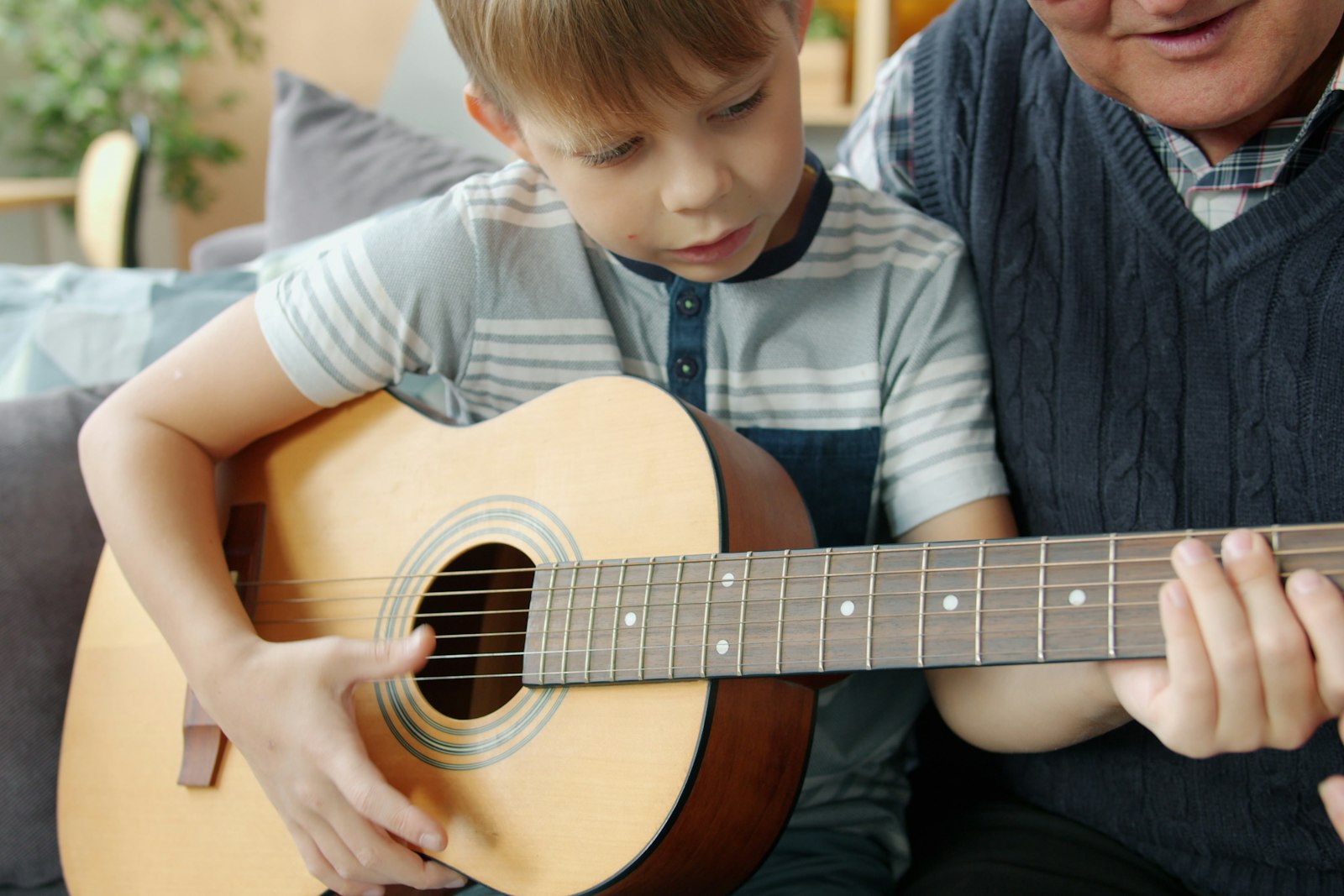
Skip long practice sessions if you’ve started an instrument. Ten focused minutes beats thirty resentful ones, and at six the habit matters more than the hours.
Skip the idea that it’s too late to start. It isn’t. Six is a completely normal age to begin an instrument, and children who start now often catch up quickly to those who started at four — the developmental groundwork was being laid the whole time.
Where Mailbox Melodies Fits at Six
Six is the age where I’d stop calling it a toddler subscription without hesitation.
A six-year-old reads the zine themselves. They follow the song words. They do the craft without help and improve on the instructions. They’ll tell you which track they’d have cut. What I write for this age has more words per song, more verses to hold, and more that rewards a child who is now reading — which is a different job from writing for a two-year-old, and honestly the more fun one. The classes I still teach are where I find out whether it worked.
The mailbox part still works, which continues to surprise parents. A six-year-old who can do almost everything themselves will still run to get something with their own name on it. It ships on the 15th every month — CD, zine, stickers, often a craft, plus a download code. $19 a month, shipping included, cancel anytime.
- Bryant, P. E., MacLean, M., Bradley, L. L., & Crossland, J. (1990). Rhyme and alliteration, phoneme detection, and learning to read. Developmental Psychology.
- Jaschke, A. C., Honing, H., & Scherder, E. J. A. (2018). Longitudinal analysis of music education on executive functions in primary school children. Frontiers in Neuroscience.
Questions Parents Ask About Music at Six
My six-year-old suddenly won’t sing in front of us. What happened?
Self-consciousness, almost certainly, and it’s developmentally on time. The best response is to keep music happening around them without an audience dynamic — sing in the car, sing while cooking, don’t turn and look. Most children come back to it, and quite a few are singing plenty when they think nobody’s listening.
Is six too late to start an instrument?
Not remotely. Six is a common and good starting age — reading skills make notation easier, and the attention span is there for short daily practice in a way it usually isn’t at four.
Do music lessons help with school?
Some research has found associations between music training and executive function in school-age children, though results vary and the causal picture is still debated.[2] I’d start an instrument because a child wants to play one — the academic angle isn’t strong enough to justify a fight.
How do I keep music going now that school takes the day?
Attach it to something that already exists: the car, dinner cleanup, the fifteen minutes before bed. Six-year-olds have less loose time than they did a year ago, so unattached music tends to vanish.
What about after six?
The songs get longer, the taste gets stronger, and the mailbox somehow still works — here’s what music looks like for big kids.

— Ms. Chelsea
Written by
Ms. Chelsea
Before starting Mailbox Melodies, Chelsea created Grape Jammers Music, a music education business in Napa, California, where she still teaches toddler music classes today. She has also taught preschool, is classically trained in voice, and has over 30 years of stage experience — including professional performances at Disneyland and SeaWorld. These days she writes and records the songs, draws the zines, and packs every envelope herself, and tries it all out on her own two little ones for inspiration.
Read Chelsea’s letter →How it works
Music class, delivered to your mailbox
The songs in this article are the kind I write every month — and mail to your child with their name on the envelope.
Join
Sign up in under a minute, for your family or as a gift.
Ms. Chelsea gets to work
She writes and records the month’s songs and packs every envelope herself.
Watch the mailbox
Real mail arrives with your child’s name on it. Pop in the CD and music class begins at home.
$19 a month · ships on the 15th · cancel anytime
See How It WorksScreen-free music mail for developing minds.