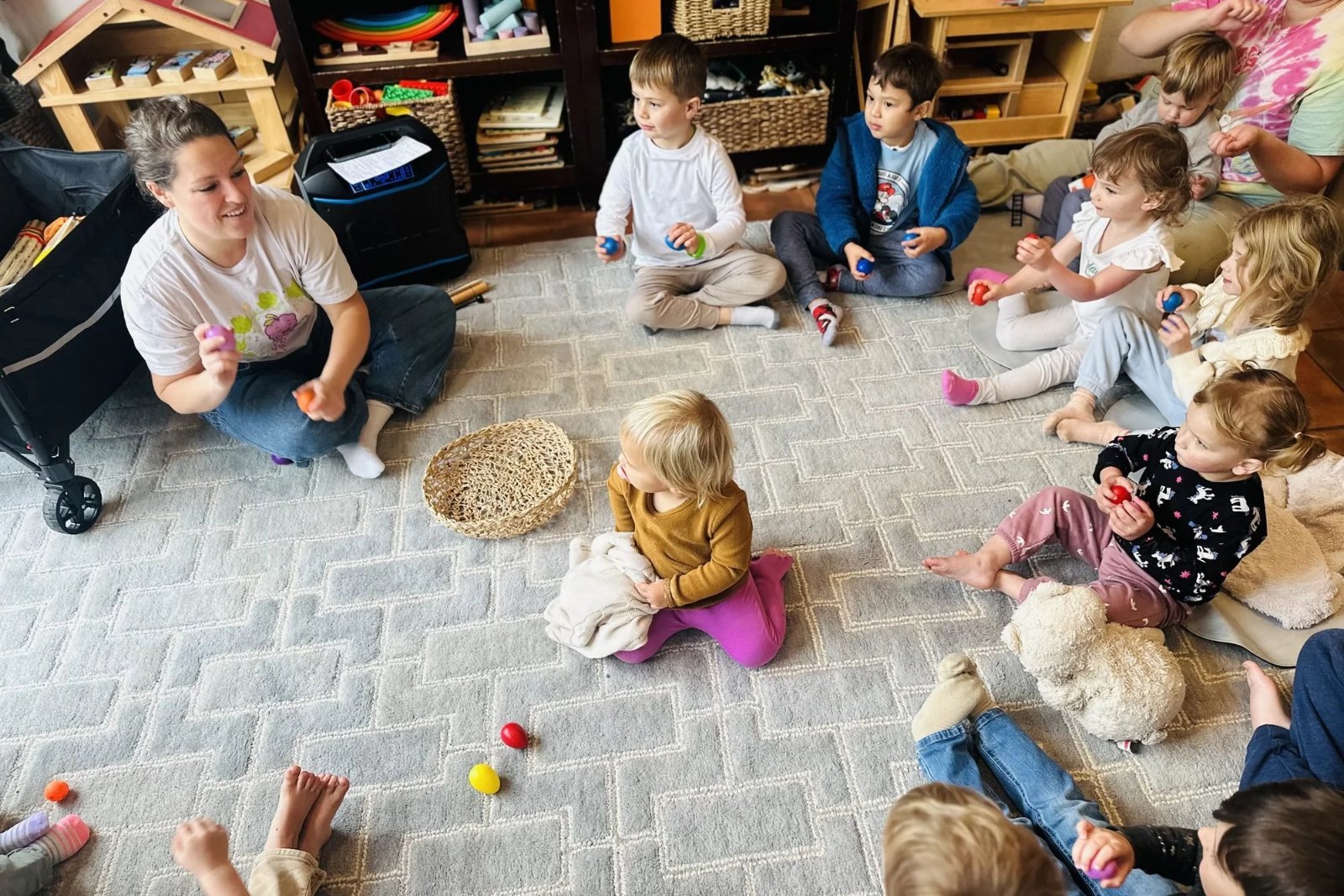
You can spot the one-year-olds in a mixed class without looking at a single birth date. They’re the ones who hear the first note of a song and immediately run to the front row about 5 inches from my face, absolutely no smile, entirely focused.
I love when this happens. It’s the first unmistakable sign that a child isn’t just hearing music, they’re answering it. And at one, the answer always comes out through the body first.
If you have a one-year-old, that’s the year in a sentence: their ears got a head start in the first year, and now the rest of them is catching up. (The full toddler guide covers the whole arc; this is the one-year-old stretch.)
One Is a Whole-Body Year
A one-year-old’s musical vocabulary is physical. They bounce, sway, spin, stamp, and bang — usually enthusiastically, almost never in time. That’s not a shortcoming. Research suggests rhythmic movement to music appears very early in life, while reliably matching an external beat comes much later.[1] Your one-year-old is responding to music, not tracking it.
What else is going on this year: they’re standing and then walking, which changes everything about how they can move to a song. They’re pointing, which is how they’ll start requesting songs before they can name them. Most are saying a few words and understanding many more.
The most useful thing to know is that at one, the hearing is far ahead of the doing. A one-year-old who has never sung a note may still know a song thoroughly — you’ll find out the first time you get the words wrong and get a very sharp look.
QUICK SCIENCE Anticipation is the skill to watch this year, not rhythm. When your child raises their hands before the “up!” in a song, they’ve internalized the shape of it. That’s the real milestone, and it’s invisible if you’re only listening for singing.
Six Songs That Land at One
The songs that work at this age either move the body or end in something exciting.
Row, Row, Row Your Boat — done facing each other, holding hands, rocking. At one, a song you do with someone beats a song you listen to, and this one comes with a built-in physical partner.
Pat-a-Cake — hands, a rhythm, and a name at the end. The clap-and-roll sequence is one of the earliest musical patterns most children can produce.
The Wheels on the Bus — the gestures are the entry point. A one-year-old will do “round and round” long before any words show up, and doing it is how the words arrive later.
Ring Around the Rosie — the falling-down is the whole song and everybody knows it. It’s also a song with a structure — build, pause, payoff — which is a surprisingly sophisticated thing for a one-year-old to be learning to expect.
Head, Shoulders, Knees and Toes — a body map. Do it slowly at one; the speed version belongs to the twos.
Any bouncing song on your knee — Trot Trot to Boston, This Is the Way the Ladies Ride, whatever your family has. The “drop” at the end is the best predictor-training a one-year-old can get.
They’ll want the same three of these on repeat for weeks. That’s not a phase to break — it’s how a song moves from the outside of a child to the inside.
Three Things to Try This Week
Give them something to hit. A wooden spoon and an upturned pot is a legitimate first instrument, and it’s better than most things marketed as one. What matters is that the sound happens when they decide it happens.
Sing while you move them. Getting into a car seat, going up stairs, being lifted out of the bath — attach a song to the motion. The motion teaches the rhythm without either of you working at it.
Stop mid-song and wait. Sing a song they know, freeze right before the exciting part, and hold it. One-year-olds will lean, kick, or shout to get you to finish. That’s a request, and it’s one of the first real conversations you’ll have about music.
TRY THIS AT HOME Try a “fast and slow” round of a bouncing song. Bounce at normal speed, then very slowly, then very fast. The slow one usually gets the biggest reaction — one-year-olds find deliberate slowness genuinely funny.
What You Can Skip
Skip the electronic toy with fifty songs. It plays the same twelve seconds regardless of what your child does, which is the opposite of the responsiveness that makes music useful at this age. A rattle and your voice outperform it.
Skip trying to get them to clap on the beat. Clapping in time is typically a four-or-five-year-old skill. Asking for it at one just adds a thing to fail at.
Skip the pressure around dancing “properly.” The knee-bend is dancing. So is spinning until they fall over.
And skip comparing. Some one-year-olds move to everything; some sit stone-still and take it all in. Both are listening.
Where Mailbox Melodies Fits at One
One is the age where the envelope starts to be interesting to the actual recipient.
A one-year-old can’t read their name, but they can recognize that something is being handed to them — and the sticker sheet, the paper, the crinkle of it are all part of what arrives. The songs are the point, but the ritual is real.
What I write for this age leans slow and repetitive on purpose, with a lot of built-in pauses, because that’s what a one-year-old can actually use — and because I get to watch a roomful of one-year-olds respond to it in class before it ships. Each month brings a CD, a zine of things to do together, stickers, and often a craft, and it ships on the 15th. You’ll use the zine more than they will this year — that’s expected, and it’s how it should work at one. $19 a month, shipping included, cancel anytime.
- Zentner, M., & Eerola, T. (2010). Rhythmic engagement with music in infancy. Proceedings of the National Academy of Sciences.
Questions Parents Ask About Music at One
My one-year-old doesn’t dance at all. Is that a problem?
Almost certainly not. Plenty of children take music in completely still for months and then start moving all at once. What’s worth noticing is whether they respond in any way — stilling, watching, brightening. If your child doesn’t respond to sound at all, mention it to your pediatrician; a lack of dancing on its own isn’t a flag.
How much music should we do in a day?
Short and intentional beats long and background. Three or four songs attached to real moments — waking, car, bath, bed — does more than a playlist running all afternoon, which mostly teaches a child to tune music out.
Should I be doing a music class at this age?
If you enjoy it, yes — mostly for the reason people don’t expect. The class gives you songs and confidence, and the singing that happens at home afterward is where the benefit lives. I’ve taught those classes for several years and still teach them every week, and the families who get the most out of them are the ones who sing in the car on the way home.
Are wooden instruments actually better than plastic ones?
Not for developmental reasons — a plastic shaker and a wooden one do the same job. What matters is whether the sound is controlled by your child or by a battery. Anything they have to do something to is a good instrument.
When will they start singing?
Often a few words late in the second year, with real fragments appearing at two. Two is when the singing starts coming back out, usually one last-word-of-the-line at a time.

— Ms. Chelsea
Written by
Ms. Chelsea
Before starting Mailbox Melodies, Chelsea created Grape Jammers Music, a music education business in Napa, California, where she still teaches toddler music classes today. She has also taught preschool, is classically trained in voice, and has over 30 years of stage experience — including professional performances at Disneyland and SeaWorld. These days she writes and records the songs, draws the zines, and packs every envelope herself, and tries it all out on her own two little ones for inspiration.
Read Chelsea’s letter →How it works
Music class, delivered to your mailbox
The songs in this article are the kind I write every month — and mail to your child with their name on the envelope.
Join
Sign up in under a minute, for your family or as a gift.
Ms. Chelsea gets to work
She writes and records the month’s songs and packs every envelope herself.
Watch the mailbox
Real mail arrives with your child’s name on it. Pop in the CD and music class begins at home.
$19 a month · ships on the 15th · cancel anytime
See How It WorksScreen-free music mail for developing minds.